Friday, May 24, 2019

Late Spring Aeration


Deep, solid tine aeration

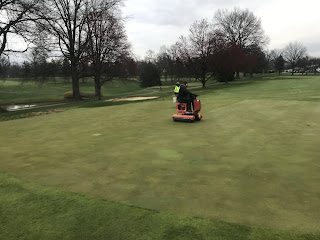
Deep, solid tine aeration was completed on Tuesday, May 28th. A contractor using a pull behind aerating unit with 5/16" solid tines was used on all of the greens. The tines go into the soil around 8" to 10" inches. We aerate greens three times a year; deep, solid tine aerate in the spring, needle tine aerate in mid-summer, and core aerate in the early fall. The benefits of aeration are as follows:

  • Decreases organic matter (thatch) which lessens disease presence, and helps water and nutrients to penetrate into the root zone.
  • Alleviates soil compaction caused by foot traffic.
  • Helps to create a smooth putting surface
  • Helps with water drainage, especially on soil based greens.
  • Promotes healthy and deep roots helping the turf get through the hot and stressful summer months


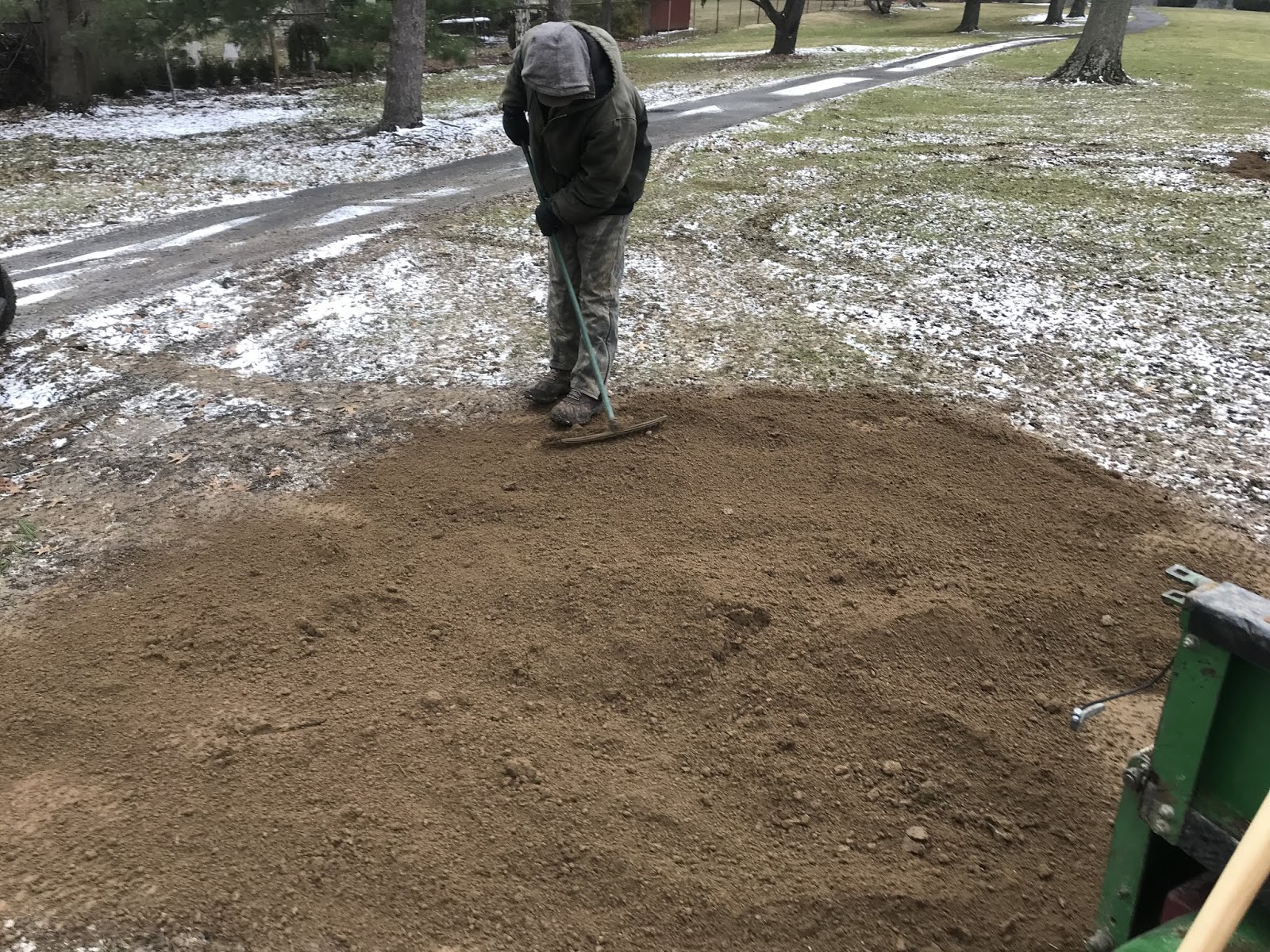
topdressing after aerating

aeration holes


Aeration has to be done when the grass is growing to minimize damage and allow for a quick recovery back to optimal playing conditions. Sand topdressing will be applied after aeration. I wrote about the benefits of topdressing in a previous post. In short, aeration needs to be done to maintain a healthy green. There will be a short term impact on playing conditions, yet within a week, the conditions will be improved. 

For more information click here for a very informative USGA article on aerating.

Thursday, May 2, 2019

Singing in the Rain?

   Singing in the rain was a 1952 film starring Gene Kelly that showcased the star actor enjoying a nice spring rainstorm. Trudging through the rain may be a better title for the way the grounds department is currently dealing with the abundant amount of rainfall that has descended upon the course. After a 2018 that went down as one of the wettest years on record, 2019, so far, has started where 2018 left off. The first 4 months have been the fifth wettest on record with over 23”. April is typically our wettest month of the year and we were over an inch above normal for that month. We were hoping that April showers would bring May flowers, but the current forecast is looking like the present month will just bring more showers. This much rain hinders us on many of the jobs that we need to get accomplished. Mowing is one of our top priorities this time of year and has to get done, especially on our putting greens. Letting the greens go longer then a couple of days without mowing could be disastrous for the bentgrass, causing scalping, slowing down green speed,  and encouraging more poa annua to take hold. So we have to be aggressive and not let the grass turn into a jungle; that breaks mower belts, and scalps turf.

Our new pond on #18 fairway


  In between monsoons, we were able to get other work done. One of the jobs accomplished was fertilizing all of our rough areas. We use a 13-0-0 fertilizer with dimension to control crabgrass. We put this down using a pro gator and a lely spreader. This greens up the rough and helps it to thicken up with new growth. The dimension is a preventative crabgrass control that will keep the crabgrass from germinating in many of these areas for up to 3 months. Next up, tees and fairways.


Mike Westendorf applying rough fertilizer


  Also, we have begun our greens spraying program. Our first application consisted of some nitrogen, and iron that help in the overall health of the greens. Also a chemical was sprayed to suppress diseases such as dollar spot, and cool season brown patch. Lastly a plant growth regulator was added to suppress poa annua and slow down growth. Fairways and tees will be sprayed in the near future.
The boom sprayer ready for its first run


  Tree work has again made its way on our to do list, but this time it comes in the form of blowing off spring time debris. The maple seeds (samaras) and oak flowers are abundant this time of year and have to be blown off before mowing and sometimes a couple of more times in the afternoon. Also, a branch from the honeylocust tree near #9 fairway bunker was removed because it was blocking shots hit from inside the sand trap.
Oak flowers covering a green

Red Maple helicopter seeds covering a green

Honeylocust branch removed


  On the horticulture side, the tulips have put on their show and are ready to be removed to make way for the summer annuals. After the tulips are pulled out they will be placed by the grounds department building and anyone that would like to enjoy them in their own gardens can take one, two, three, or a hundred of them home. The bloom cycle continues to roll on with the hawthorn trees, buckeye trees, rhododendrons, azaleas, dogwoods, and spanish bluebells stealing the show.  The landscape bed behind three green was designed to have an Augusta type feel. The azaleas and dogwoods that are common at the Masters are now here at WHCC and look very nice, in bloom, as a backdrop behind #3 green. The hydrangeas will bloom for the summer months, and this landscape bed should get bigger and better with every passing year. The summer annuals will be filling in the clubhouse beds in the next coming weeks, and hopefully mother nature will turn off the faucet and allow us to stop Trudging in the rain!

#3 green landscape bed


Spanish bluebells in bloom


Brad Piecuch
Assistant Superintendent/Horticulturist


Tuesday, April 16, 2019

Topdressing

 I want to give an update pertaining to the topdressing that was accomplished on the greens today. There are many benefits to sand topdressing and they include:


  1. Improving the smoothness of the greens, making the green faster after a couple of days.
  2. Decreases thatch
  3. Decreases disease presence
  4. Fills in unfixed ball divots
  5. Helps with better drainage
  We accomplish this by towing a topdressing machine with a gator pro cart. After the sand is applied it has to be drug in with a drag mat, the sand is then watered in, and the next day the greens are mowed with old walk behind or old riding reel mowers to collect any excess sand.

Topdressing the putting green

Sand on #17 green after topdressing

#17 green after sand is drug in with a drag mat

  The putting greens will be slower for a couple of days after we top dress. They will speed up after the sand works its way into the root zone and fills in the divots. Ultimately, the speed of the greens will increase and will help the green speed stay more consistent moving forward. We plan to do this practice on three week intervals, dependent on the weather and special Monday events.

For more information on topdressing click here

Thursday, April 11, 2019

April Color

Tulips in bloom
  The spring annuals are in full swing at WHCC. The daffodils are in full bloom, the tulips are putting on flowers, and the pots and window boxes are filled with pansies, tulips, and hyacinths. Many flowering trees and shrubs are in full spring color, such as, magnolias, redbuds, pears, serviceberries, and viburnums.  As the temperature warms many other plants will put on blooms and it is looking like the tulips will be in full bloom for Easter Sunday.


Daffodils in full bloom

Pansies, hyacinths (good fragrance), and tulips in pots
Appalachian Red Redbud behind #9 green
Lavender Twist Redbud

Tulips starting to bloom


Saucer Magnolia in bloom

Star Magnolia in bloom

White daffodils
 
  Many of you may have noticed the new landscape bed we put in behind #11 green. The plants included in this design are an autumn brilliance serviceberry tree, mini mauvette hydrangeas, Blazing star kobold, coreopsis 'zagreb', and karl foerster feather reed grass. The serviceberry is currently in full bloom, but all the other shrubs and perennials are just coming out of winter dormancy. They should fill in nicely in the upcoming months.
New landscape bed #11 green


  On the turf side, much of the cool season grass is exploding out of its winter dormancy. However as the grass grows so does the springtime weeds. Some of these weeds include dandelions, purple deadnettle, chickweed and violet. One of the most invasive spring weeds is lesser celandine. It is a short lived perennial that is on the rise in our area. It is a non native plant brought here from Europe in the 1800s. It blooms in the spring, then dies down to the ground in the summer and returns the following spring as an expanded colony. It forms a dense mat that chokes out many of our native woodland plants. We are currently making herbicide applications to eliminate this weed and the other springtime weeds that invade the golf course.

Lesser celandine in the woods by 4 tee

Dandelions 
  Another one of our "favorite" turfgrass weeds is putting on seed heads and is easy to spot this time of year. Poa annua (annual bluegrass)  is spread all throughout the golf course and is much more difficult to control then the other broadleaf weeds. It is a winter annual that puts out seed in the spring, dies in the heat of the summer, and germinates again in the cooler temperatures of autumn. It differs from kentucky bluegrass by its lighter green color and has a light color ligule. We do use some chemicals to suppress its growth but it is very difficult to fully eradicate. I am sure I will have more to say about this plant during the summer months.

Poa annua seed heads

Poa annua and Kentucky bluegrass seed heads mixed together

   Some areas of the course were torn up because of wear and tear or because of the late season ice storm with the subsequent cleanup work. Over the last couple of weeks a repair crew has laid down new fescue sod in many of these areas and in some of the stump hole areas.

Fescue sod added around #18 bunker face

    The irrigation system is now up and running. To accomplish this we had to turn on the main valve, pressurize the pumps and the system to get up to 100 psi, and bleed out the excess air by turning on each irrigation head. A couple of heads had to be replaced because of bad seals and water pressure damage but now the system is ready to go, once it stops raining.

Spring startup of the irrigation system

 Finally, I wanted to write a little about our greens maintenance program that is under way. We have verticutted the greens. This consists of slicing grooves into the green with a triplex riding mower with a slicing blade attachment. This stimulates turf growth, tightens up the turf, improves smoothness, and opens up the turf's root zone which alleviates some compaction allowing for more nutrient uptake. (for more about verticutting click here) We, also, will be topdressing in the next couple of weeks. This will help smooth out the green, increase green speed, and decrease disease presence.  Fertilization is also imperative for maintaining a healthy green and we will be beginning that process soon with liquid and granular applications.

  This year we will be rolling the greens more often to increase green speed. We have two rollers. A light weight triplex roller and a heavier salco roller. The light weight roller is faster and less impact-full on the turf. It increases the green speed by about a foot. The heavier salsco roller takes more time to use but increases the green speed by about 1.25 feet, and it makes the green faster for a longer period of time. Both of these rollers will be used often during the golf season to maintain a consistent green speed.
Green after veticutting

Light weight roller

Salsco roller


Brad Piecuch
Assistant Superintendent/Horticulturist

Friday, March 22, 2019

Spring has Sprung!

 Spring is starting to show up throughout the golf course. The cool season grasses are doing their part in celebrating St Patrick's day by turning from the brown color of dormancy to bright and dark shades of green. Some of the first flowering trees and shrubs are starting to come into bloom and the spring flowering bulbs are getting ready to put on a show. Growing degree days is how we measure bloom times for plants and we (in western hills) are currently at 65 GDDs. Right now is the time for red maples, forsythia, cornelian cherry dogwoods, and magnolias to start blooming. We are behind the bloom times from the last two years but that is because we had a cooler February and early March then the previous years.The Ohio State University puts out a very informative website to track GDDs for our area and can be accessed by clicking here.

Our neighbors' cornelian cherry dogwoods in bloom 


Red Maple coming into bloom


Tulips appearing in landscape bed


  Spring is a transition time for the grounds department. We finished up the winter tree work which included taking down 12 dying/diseased trees in house and 6 hazardous trees that were taken down by Gregory Forrest Lester. However, the removal of these trees is just the beginning of the process. The leftover stumps have to be ground up, the grindings removed, dirt added, and finally seed and straw put down. We are at the final stages of this process and we should be finished in the coming week. Also, in early March, we were able to get all the bunkers and landscape beds edged with a walk behind edger. This will give the bunkers a nice crisp edge to start off the golf season and will be maintained by trimming on an every other week basis. On the horticulture side, we are beginning to clean out beds, cut down perennials, and mulch all of the clubhouse and golf course landscaping.


First cut in felling red maple on #7 

Filling in stump holes with dirt

Edging on a landscape bed

Bunker before edging

Bunker after edging


  The driving range will be getting some additional mats added and we just finished up the excavation of those areas. The next steps will be to pour the concrete and add the new mats. This should be accomplished by mid April.

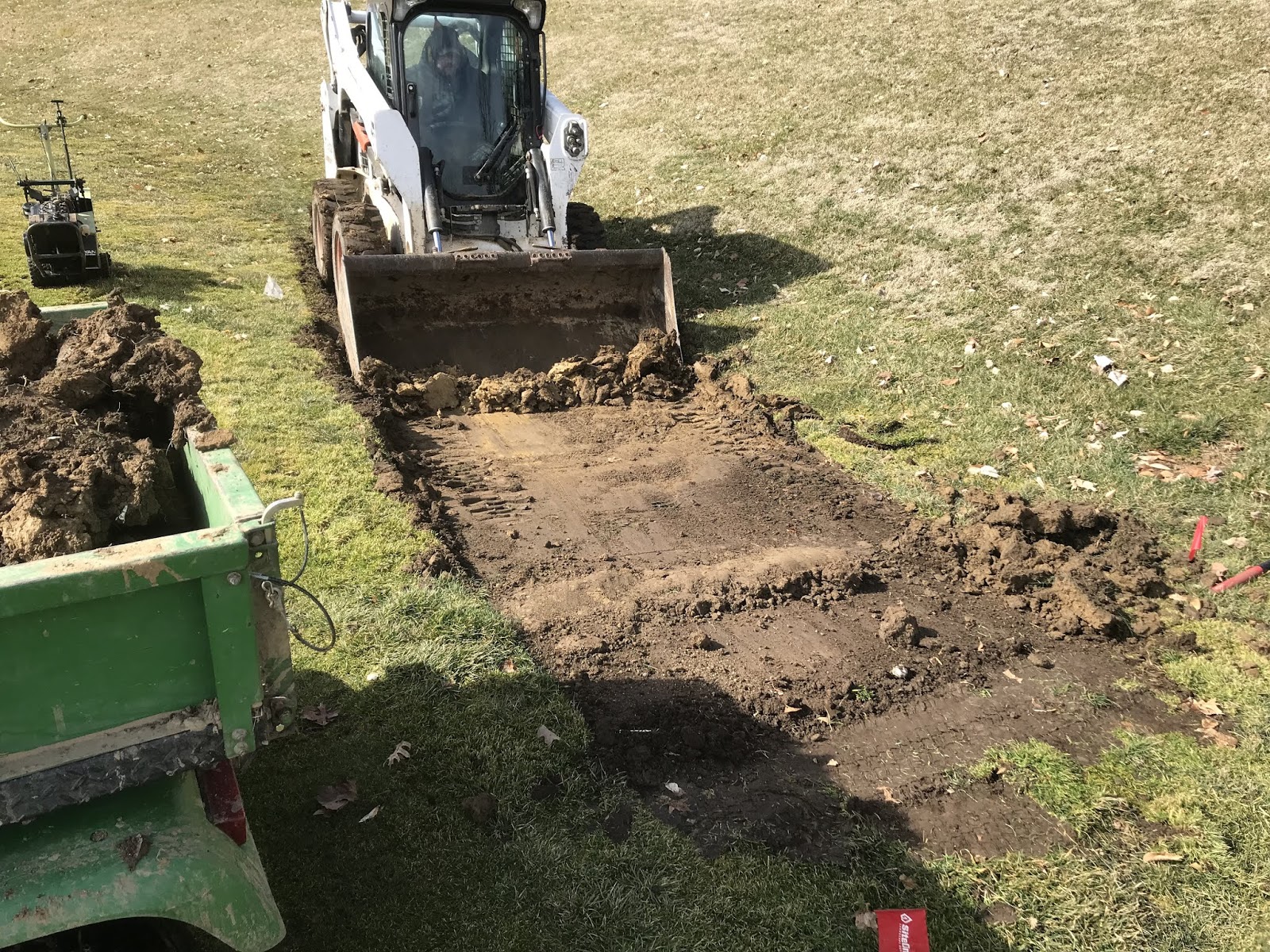
Excavating area for mats on the back practice tee


  The mowing operation has begun and will be picking up steam in the next couple of weeks. The greens have been rolled and mowed three times and the first mowing of the fairways has been concluded. Next up will be tees, approaches, and finally rough. The green's height of cut will be slowly lowered as the ground temperature begins to warm up to optimal growing conditions. This along with increased mowing, rolling, and topdressing should allow us to pick up the green speeds to our desired stimpmeter readings by May.

First cut on #3 green

First cut on #6 fairway


  Finally, as many of you already know, Delhi Hills golf course has seen its last days. We have taken advantage of the course's final hours and have been able to cut out bentgrass sod from the 9th green. Bentgrass sod is difficult to obtain in our area with the closest distributor residing in Pittsburgh. The sod will be used for touching up bad areas on our practice tees and replenishing the bentgrass nursery on the driving range. So in a small way the Delhi course will live on at WHCC for years to come!

Delhi Hills Golf Course #9 green

The beginnings of our tee/fairway bentgrass nursery

New bentgrass sod added to far practice tee

Brad Piecuch
Assistant Superintendent/Horticulturist


Friday, February 15, 2019

February update


   We survived the Polar Vortex! We dropped down to -7 F at our weather station. This almost certainly will be the lowest temperature for the winter this year and it is above our threshold of -10 F for zone 6. However, it is close enough that we may have some damage on tender plants for this region such as southern magnolias, crape myrtles, azaleas, and butterfly bushes. Only time will tell.
 
   Despite the recent winter weather, the grounds department has remained busy with winter projects. Tree work is going along smoothly, with most of the dead/dying trees scheduled to be removed already cut down. Many of these dying trees were Austrian pines and Scots pines that have been infected with a fungal disease called diplodia tip blight. These two trees are the most susceptible hosts to this disease. The disease starts at the tips of the branches of these evergreens with the needles turning brown. It quickly spreads to the rest of the plant, especially during wet weather, and eventually kills the entire tree. There are now only a few of these pines left on the course and they all will eventually succumb to this disease. During the recent cold snap, three pin oak trees on the right side of 7 fwy were taken down (by Gregory Forrest Lester) as well as an ash tree on the right side of 1 fwy that had the emerald ash borer. The pin oaks on 7 fwy had much damage from the recent ice storm; one also had damage from a lighting strike, and two out of the three trees were starting to encroach into the fairway. The tree company also pruned low branches and dead limbs out of 10 pin oaks located throughout the course.

Image result for diplodia tip blight
Pine tree with early onset of diplodia tip blight (photo from another course)

cutting down dying black locust tree


Internal decaying problem indicated by mushroom growth on the trunk


Pin oaks removed by 7 fwy left us with a lot of cleanup work


   Pruning of dead and low lying limbs has also taken place throughout this winter. Many of our white pine trees have a significant amount of dead stubs that we have been pruning out. Other projects that we have been working on include: widening of the cart path by 4 tee, attending turf seminars, course cleanup, making instant programs on the lynx irrigation system to help with watering efficiency, seasonal staff recruitment, and beginning to dormant seed areas of the rough.

white pines by #4 tee limbed up for foot traffic and better sunlight exposure for the turf by 3 cart path


cart path expanded by #4 tee. black top to be added when warmer


white pines on #7, stubs pruned out

Tri-state Green Industry Expo trade show

Tri- state Green Industry Expo seminar


Instant fairway program for dry spots on toro lynx
   As we enter the last leg of winter and into early spring, I think it is important to touch base on winter play and course conditions. There are four main reasons why the course may be closed or delayed during the winter months. They are frost, frozen ground, thawing ground, and very wet conditions. Frost and frozen ground can cause significant damage to the turf when walked or driven on. Thawing ground can cause root damage from foot traffic when the top layer of the soil is thawed and the lower layer is still frozen. Any traffic during this scenario will break the roots in between the two layers. Wet ground is much more common this time of year from heavy rainfall, low evapotranspiration rates, and the dormancy of the turf. (prohibiting any water uptake). Walking on highly saturated soil will cause deep footprints that will create craters and unevenness especially prevalent on putting greens. For more information on winter play click on this informative article by the USGA .
Cart traffic damage from driving over frozen turf

Ball marks slow to heal during bentgrass winter dormancy

Brad Piecuch
Assistant Superintendent/Horticulturist