Sunday, January 29, 2023

What do you guys do in the Winter?

 What do you guys do in the winter? Do you play cards or take naps? It must be nice to have the whole winter off. You could not possibly have anything to do this time of year, after all, the grass isn't growing-I have not mowed my lawn in three months! If I had a dollar for every time asked this question, I would be spending my days with the rich "influencers" on some warm remote island, off the coast of some country I can't pronounce. However, contrary to popular belief we still do work throughout the winter months. One of my colleagues had the best answer when he said, "Winter is the best time of year, a time when we can actually get some work done!" No truer words have ever been spoken! During the golf season 85-95% of the crew's time is spent doing daily maintenance tasks- i.e., mowing, rolling, spraying, watering, changing cups, raking bunkers, etc... In the wintertime these maintenance tasks slow down enabling us to accomplish much needed projects that we just did not have enough time to complete during the golf season.

One project at WHCC that occurs every winter is tree work. With around 1,000 trees on the property, there are always arboriculture duties to carry out. Every October a tree evaluation report is discussed with the Green Committee about unhealthy/problematic trees that need to be removed. The bigger trees (mostly pin oaks) are removed by a tree company. The smaller problem trees are removed in house. Also, many trees are pruned to remove large "in play" branches and dead or diseased limbs that may pose a safety hazard. We work within a budget and prioritize the most at risk trees for removal.

Cutting down an ash tree infected with the emerald ash borer.


Tree company pruning a pin oak by the parking lot.

Black Locust tree removed.

Pin oak removed that had honey fungus disease.

Trunk area of a red oak tree that we noticed had a significant ganoderma infection. The tree would have eventually fell due to the remarkable amount of decay caused by the infection.

Winter mechanical work is another important undertaking the crew tackles in the off-season months. It is an annual occurrence that takes place after the mowing has ceased for the year. All the mowers have to be torn down and rebuilt to achieve good mowing results for next season. There is a different degree of maintenance required for different units depending upon their usage. Some of this maintenance includes:

  • The grinding/sharpening of all the walking and riding reel mowers
  • Rebuilding the bearings and seals on reel mowers.
  • Grinding of bednives to aid in the reel-to-bednife relationship to achieve optimal mowing results.
  • Pressure washing of all the grounds equipment.
  • Greasing the mowers.
  • Oil changes on the riding equipment.

All of this mechanical maintenance takes the majority of the winter months to accomplish and is a crucial part in maintaining a quality golf course. 

Grinding a greens mower.


Over the last two years the grounds department has been working on building maintenance, upgrading many areas of the grounds building. The old electric has been replaced and updated with LED lights, new ballasts and many new 120-volt receptacles added, a portion of the leaky roof replaced, a lift has been inserted, heaters installed on the old cart barn wing, broken garage doors replaced, and material storage bins have been created. These are much needed upgrades that will, hopefully, keep the oldest building on property functional for years to come.

Installing new electric Dayton heaters in the old cart barn wing.

Lift installation

Lift installed.

Your truly unloading 3,600 lbs concrete barrier blocks.

Installing concrete barrier blocks to create bins for material storage.


New material storage bins, used for topsoil, topdressing sand, bunker sand, mulch, and gravel.


Landscape construction projects are always fun and exciting assignments to undertake. Most of the landscaping around the clubhouse was completed in the early 1990s and is in need of an upgrade. Also, some plants on the course were planted much earlier and have outgrown their environment. Winter is the perfect time of year to accomplish these tasks which include construction of new landscape beds, hardscape installation, and demolition of unwanted vegetation.

Removing taxus bushes next to #7 tee.

Using the mini track loader to take out the taxus bushes.

Landscape design for new "honor" garden in the fountain area and an upgrade to the adjacent perennial garden.

New retaining wall installed. around the pro shop last winter season.

Garden steps installed between the cigar hut and outdoor bar.

Drainage work is something that almost every golf course can use more of and WHCC is no exception. There are many areas throughout the course that retain moisture either due to low lying areas, underground springs, or the heavy clay soil that constitutes much of the Western Hills soil structure. The crew has been hard at work trying to dry up some of these location during the shoulder months.

Drainage in #7 fairway

Installing a catch basin in #7 fairway valley

Fixing the area in front of #1 tee where water frequently pools.

Drainage work in #6 valley

One of the most important winter assignments is keeping up with agronomy education. Many crew members have certifications that require credits through education seminars. GCSAA (Golf Course Superintendent Association of America) points, ISA (International Society of Arboriculture) CEUs, and Ohio pesticide credits are all examples of education that must be meet in order to keep certifications and, in the case of pesticide licenses, must continuously be updated in order to spray plant protectants on the property. Most of the education is achieved through conferences and trade shows. This also gives us an opportunity to network with other Green Industry professionals and allows us to learn the new and ever-changing horticulture practices.

Tri-State Green Industry Expo trade show at the Sharonville Convention Center

Green industry professionals at the Tri-State Green Industry Expo

A seminar on rolling frequency at the Indiana Green Expo.

Snow removal in our area is usually feast or famine. There are long winter stretches where snow is scarce, followed by back-to-back-to-back snowstorms that need to be plowed in order to keep the club operational. Even smaller sleet and ice storms require salt applications to keep the parking lot from turning into a skating rink. This can be a big job requiring 4 or 5 employees needed at different times of the day or night to accomplish. During the winter, the crew is constantly keeping an eye on the incoming weather and trying to adjust the work schedule accordingly.

Chris Wheeler plowing the lot for a third time during a heavy snowstorm.

Snow blower clearing the parking lot.

Of course, mowing rarely completely stops during the winter months with greens typically being mowed at least two or three times before the final spring warm up and the leaf removal process continuing until March. Every windstorm still requires course clean-up work consisting of leaf, debris, and stick removal labor. Also, staff recruitment and training continues throughout the shoulder season. So, hopefully, everyone now understands the importance of winter work, and perhaps next year the question will be substituted with "What do you guys do during the summer months?"


Brad Piecuch

Grounds Superintendent


Monday, January 2, 2023

Winter Damage

The course experienced some freeze burn and wind desiccation from the Christmas weekend storm. On the night of December 22nd, the temperatures dropped 55 degrees in a couple hours, the highest and fastest temperature drop ever for the Cincinnati area. Freezing rain and snow soon followed and by the next morning the wind was howling with gusts up to 40 mph. This was a historic storm and actually qualified as an official blizzard for the tri-state area. Anyone who ventured outside during the storm realized fairly quickly that this was a dangerous environment with wind chills exceeding -20 F. Frost bite could occur within minutes and unheated exposed pipes froze in hours. 

The new USDA plant hardiness zone map has the Cincinnati area in zone 6. This means that the lowest yearly temperature should be between 0 and -10 F. The WHCC weather station had -9 F as the low temperature during the Christmas storm. This is at the lowest end of the cold spectrum that plants in our area can tolerate. Many of the southern landscape plants (crap myrtles, cherry laurels, hollies, azaleas, etc...) probably will have significant damage when they break dormancy in the spring. The extreme cold negatively affected the turfgrass as well. Before the temperatures dropped, the turf was still actively growing. It was in the 40s and 50s before the bottom fell out and the turf was not ready for it. Rain, then freezing rain, then snow accompanied the cold front, and any liquid precipitation quickly froze. Snow acts as an insulator and any grass that had snow cover made it through the harsh weather without any damage. Some areas had the snow blown off by the high winter winds. It was these exposed areas that suffered damage. Once the snow melted the windrow, brown turf became evident. Multiple greens experienced significant, cosmetic damage along with many areas in the rough. In addition to the cold and wind desiccation, other locations are also experiencing some pink snow mold issues caused by the weeklong snowpack. We only spray the greens for this disease and unprotected areas are susceptible. Currently the snow mold issues are confined to some rough and fairway areas and hopefully, with warmer temperatures, they will recover. 

The good news is the wind desiccation is isolated to the top of the leaf blades and there is enough green healthy tissue underneath for recovery. It will take some time for the grass to grow out of the damage and it could be until April before the grass is back to its green, lush color. The bad news is we are in the heart of winter and I’m sure jack frost has plenty left in his tank. Another polar vortex with less snow cover could cause significantly more damage or even death to an already weakened turfgrass plant. Right now, temperatures are well above normal, and the grass is starting to grow again. Hopefully, the extreme winter weather is behind us, but we will keep monitoring and updating on conditions as we head through the winter season.


The weather station at my house in Bright, IN showing the temperature at -10 F


Hard to see but at the top of the screen the WHCC weather station shows a low of -9 F.

#16 green showing winter leaf desiccation. The wind blew the snow cover off areas of this green exposing the still growing turf. This caused the tips to freeze, and the blades quickly lost moisture from the high winds causing brown scalding to occur. Notice the wind pattern and the green turf that was still covered by snow during the high wind gusts.

Another view of #16 green.

Damage to #18 green

Winter damage to #1 fairway

Snow mold and winter desiccation to #10 rough

Winter damage to #17 rough. Notice the windrow damage in the rough caused by the blowing of the snow, exposing some turf to the elements 


Pink snow mold on #15 fairway

Close up of the damage to #18 green. Luckily the brown desiccation is limited to the upper portion of the leaf blades. There is plenty of green, healthy tissue underneath. This should only be cosmetic damage that the turf will grow out of.


For more information on winter turfgrass damage click here for an informative USGA article.


Brad Piecuch

Grounds Superintendent


Thursday, December 1, 2022

Maintenance and Project Update

Healthy new turf on the north driving range tee.

The two-year driving range project is nearing completion. Phase 1 started in August of 2021 and consisted of a new, larger south tee, a new chipping green, target greens, parking area and cart path, expanded putting green, landscaping, and new surrounds. Phase 2 started in August of 2022 and included a new north tee, a long winding cart path, an expanded hitting zone, and new trees planted. The design, earth moving/shaping, and irrigation were all contracted out. In house labor acted as the construction crew on this project and was used to install drainage; haul materials; prep areas for seed; seed, straw, fertilize, and water the new grass; plant/design landscaping; convert target greens to zoysia grass; and project manage.  The grounds crew did a fantastic job working on construction while maintaining the golf course/grounds and being heavily involved in other projects such as the Verdin clock/ #1 tee area renovation, the lighting of the champion tree, #13 green drainage/leveling, and the cart barn construction. Overall, a total of 1,892 in house labor hours were used for the entire driving range project.

The new north tee was seeded in early September and looks full and healthy going into the winter. It is amazing how quickly grass germinates when seeded at the proper time. Last year many areas did not get seeded until October and struggled to fill in while this year the results on the tee and surrounds have been much more promising. Next up will be to get the cart path paved and the safety fence built. Hopefully, the new north tee will be ready to open around Memorial Day.

Phase 1 Pictures

This was the first step of the project, spraying glyphosate in mid-August of 2021.

Old driving range tee after spraying

Constructing the new south tee

Building the new chipping green

Drainage installed in chipping green

Irrigation install

Futera matting on top of seed

Prepping chipping green for seeding

Chipping green day 1 after seeding

Putting green expansion

chipping green beginning to germinate

Planting #5 landscaping

Chipping green growing in

Winter grow cover for putting green

Sodding on the floor of the range in early March


Installing innovation zoysia grass on target greens in June


Phase 2

Shaping and clearing area

Drainage work

Bentgrass seed starting to germinate on the tee

More drainage


 Completed Project

New North Tee

Completed range floor. Innovation zoysia is a southern grass that turns dormant in the winter adding a nice contrasting color to the target greens this time of year.


Completed chipping green, south tee, and surrounds

Meanwhile, out on the golf course, we are finishing up on fall maintenance practices before the cold temperatures set in. Fairway fertilization was completed in mid-November and a granular fertilizer was applied to the greens later in the month. The practice tee was solid tine aerated this year because the new grass has not accumulated much organic matter; however, in subsequent years core aeration will have to take place once OM starts to accumulate. The project work and mother nature helped to put us a bit behind on rough aeration. We were able to complete it by the end of November, but some locations may be muddy for a while longer until the aeration plugs fully break down. Next up will be to apply snow mold protection and poa annua seed head suppression to the greens in early December.

The height of cut on the greens was raised throughout the month of November to help the grass store carbohydrates and to help the plants survive winter conditions. Understand that green speed will decrease during the off season because of decreased mowing, rolling, and topdressing. Once spring begins the greens maintenance program will resume, which will increase the green speeds. Also, the winter tee markers have replaced the in-season markers and are located on the white and green tees to let the back tees heal in before next season.

Aerating the south practice tee

Aerating rough

On the horticulture side, garden steps have been installed between the cigar hut and outdoor bar. This should give a clear level pathway for people transporting between the hut, bar, and pool. The springtime bulbs are currently being planted. There are around 5,000 tulip bulbs planted around the clubhouse grounds. It is recommended to have them planted to allow for at least 8 weeks of cold temperatures, which helps the bulbs to bloom on time for their April display.

Installing garden steps


Planting bulbs

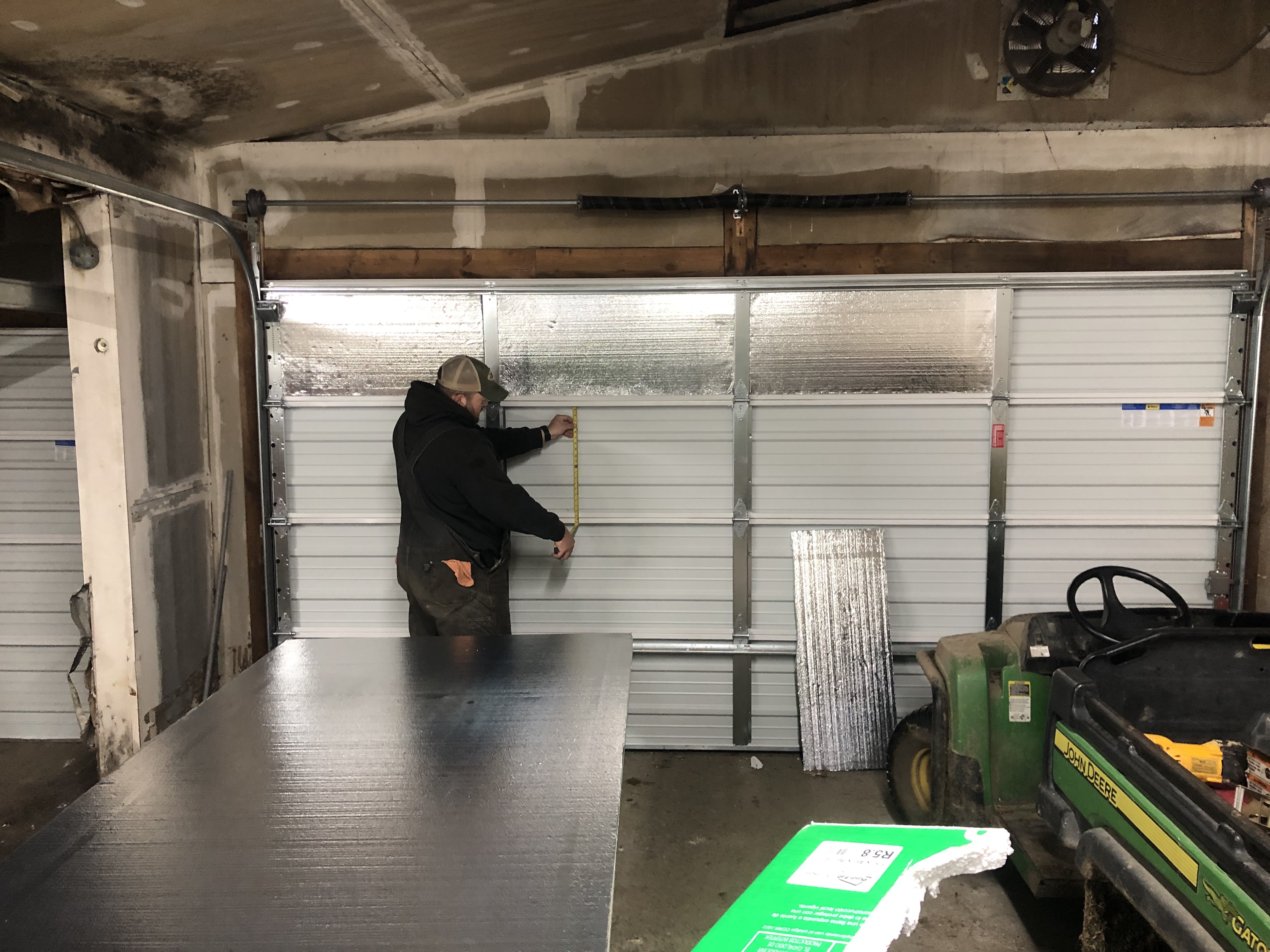
The mid November cold snap allowed the crew to get much needed building maintenance accomplished. The old cart barn wing of the grounds building is being converted to an equipment storage area. We installed two electric Dayton 15kw 51,200 Btu heaters to keep the gas and hydraulic fluid on the equipment from freezing. In addition, insulation was installed on the new garage doors to keep heat from escaping. The long-awaited equipment lift (ordered January of 2022) has arrived and will make routine maintenance much easier to complete.

Heaters installed

Inserting insulation

Unloading the equipment lift


The installed equipment lift


Christmas came early for head mechanic (Jim) and his back. Routine maintenance can now be done standing up instead of laying on the ground.

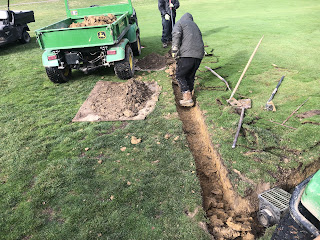
Also, the colder temperatures have allowed us to tackle some drainage projects. The area between #9 tee and #6 fairway has been extremely wet during the season because of the increased drainage on #8 green that was installed last year. All the drainage from the green and bunkers drains through the drain tile located in the wet area. Unfortunately, the old tile was clogged with roots and mud. This backed up the water and all of it drained out in front of the dawn redwood tree. This location was extremely wet and now we are installing new tile to move the water away from the area and into tile located parallel to #6 fairway.


4" drainage installed between #9 tee and #6 fairway


On the horizon will be winter tree work. The scope of the work has been approved and once we are caught up on other projects, we will begin to tackle tree excavation and pruning. Also, winter mechanical work is beginning and will take a couple months to accomplish. I will update once these projects begin, and on behalf of the entire agronomy department we wish everyone a Merry Christmas and a safe and happy New Year!


Brad Piecuch

Grounds Superintendent