Thursday, September 22, 2022

Dirty Jobs

Dirty Jobs is a popular cable TV show that highlights the importance of the trades and blue-collar workers. The host, Mike Rowe, has been a champion of the blue-collar trades, construction, and hard work. One of his famous quotes is "If everybody had an office job who would build the offices?" Or in our case who would build the golf courses? Thankfully, there are people like Russ Macke and hard workers on the WHCC grounds crew that over the past year worked extremely long hours to transition the old small driving range into a bigger, more golfer friendly complex.

Phase 1 of the driving range renovation included installing a new chipping green, expanding the practice tee, building target greens, and expanding the putting green. Now Phase 2 is building a new north tee. This phase of the driving range project is now in the grow-in stage. Much dirt was moved and shaped by Russ Macke and it is hard to remember that most of the area was a forest a little over a month ago. The drainage has been installed, irrigation pipe dug in and connected, the surrounds seeded with fescue and either strawed or matted, and the new tee seeded with bentgrass. Part of the back of the old tee was eliminated. The sod in this area was still in good shape, so before excavation we stripped the sod and inserted it into the beginning of #11 fairway, a problem area that was turning into more goosegrass than bentgrass.

 With seeding timing is everything. Last year the chipping green was the first area seeded in late September with many of the surrounds not getting finished until late October. Consequently, the grow in phase was slow with grass struggling to germinate throughout the winter into this past spring. This year everything has been seeded by mid-September which has resulted in these areas quickly germinating. The first area was seeded in late August, and we have already mowed it twice. Hopefully, the germination on the tee and surrounds continues its rapid pace.

Shaping the new tee.

New cart path and surrounds installation


Drainage being installed


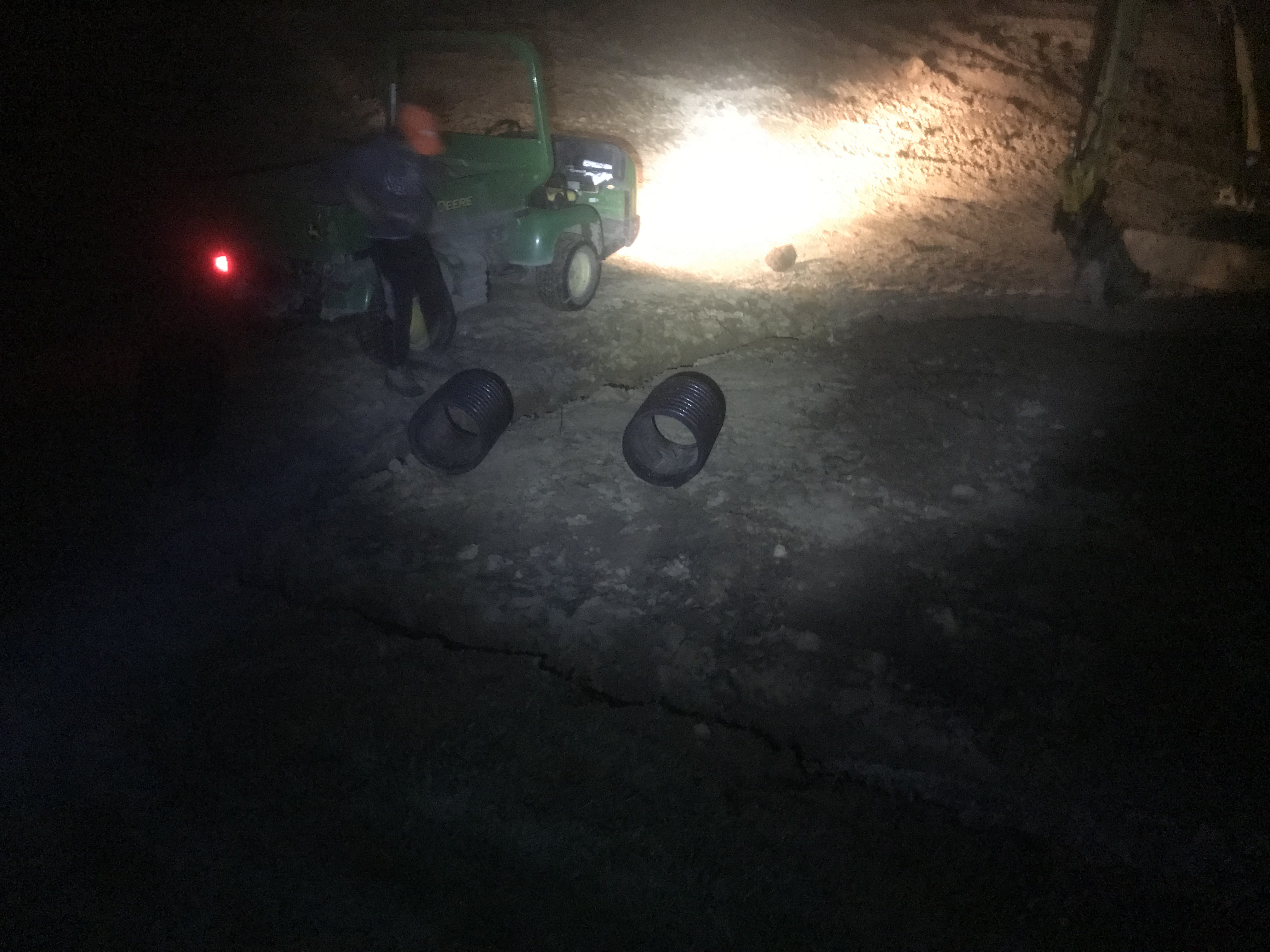
David, Raymond, Ricardo, and Miguel installing drainage pipe

Prepping the new driving range tee
                             

Germination on the tee surrounds
 

Bentgrass starting to germinate on new north tee

Wheels replacing the goosegrass infested fairway area with bentgrass sod.

#11 fairway area completed

Tee a week later


Mark and Ricardo digging in a draintile line

Hate is a strong word, but in the case of hydraulic leaks it may not be strong enough! After going over a year without one hydraulic hose leak, in the span of less than a week in early September we were graced with two. Hydraulic fluid is clear and very hard to see when it first comes out but after a couple of hours it becomes very noticeable and after a few days the turf is dead. The first one occurred on #12 short rough area and the second was on Labor Day morning on #12 and #18 approaches. Both of these pieces of equipment are older units with many hours of use. Some of our equipment is starting to show its age and we are currently looking into replacements, but we can never fully eradicate the chance of a hose breaking, even on newer equipment. The area on #12 has since been taken up and sodded and the leak on #18 is starting to heal in but it will take some time before it is unnoticeable.

Hydraulic leak on #12

Hydraulic leak on #18 approach an hour after it occurred. Just now starting to see it.

 The new cart barn area is completed. First, we installed the new landscaping, built the cart path, then removed the dying white oak, and recently shaped and seeded the back area. It also is in the grow-in phase and hopefully will start to germinate soon.

Cart barn surrounds seeded.

Slit seeding has taken place on many rough locations that died out during the hot summer months. Also, the bermuda grass on #11 and #16 has been slit seeded with intermediate ryegrass to give these areas some color when the bermuda grass goes dormant for the season.

Slit seeding rough areas

Slit seeding #11 fairway

It is that "tine" of year again for aeration. The greens were aerated on September 6th. Normally we core aerate (pull plugs) on all of the greens; however, this year midway through the process a rainstorm developed and halted the operation. After the rain ended the greens were too wet to deal with plugs that would turn into mud pies when trying to pick up, so we solid tine aerated the rest. Core aerating is more efficient at eliminating organic material than solid tine but they both are beneficial to the turf especially after a heavy topdressing, which we were able to accomplish on all of the greens. Next up are tees and we have begun to pull cores on some of them. This will continue to occur during the rest of September and into October. The fairways will be deep solid tine aerated on October 6th (course closed) and the rough will follow. We will have to work around play to accomplish most of the aeration, so we ask for patience as we try to complete this important agronomic practice.

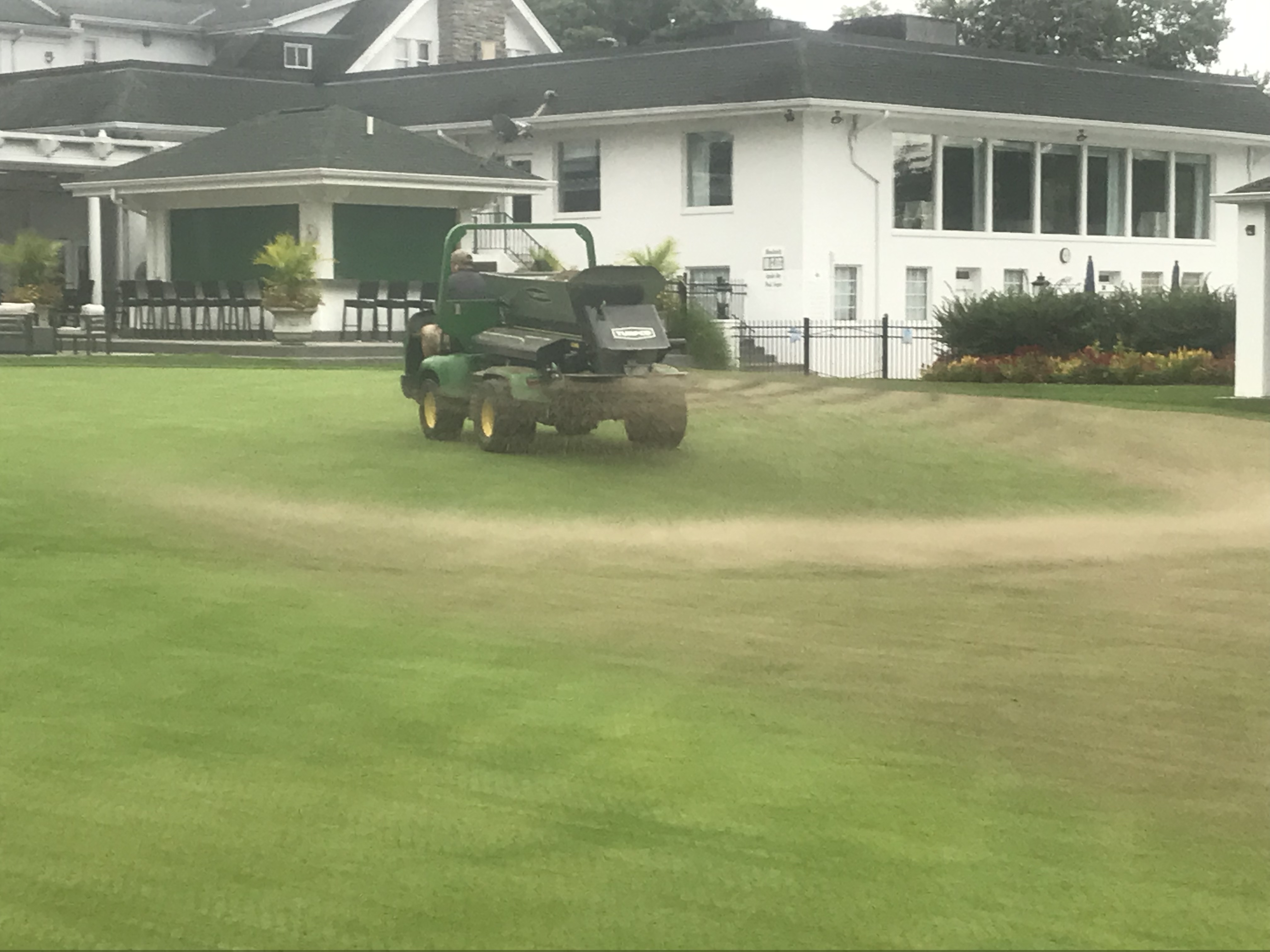
Topdressing the putting green

Aerating #13 tee

Finally, since we just celebrated Labor Day, I want to take a minute to highlight some of the outstanding work done by the crew on a regular basis to maintain this beautiful golf course and keep up with construction deadlines. Mike Rowe once said, "We're churning out a generation of poorly educated people with no skill, no ambition, no guidance, and no realistic expectations of what it means to go to work." Looking at the current labor situation it is hard to argue with this statement-where no call, no shows are commonplace, 2:00 AM morning call off text messages are the norm, and a 15-hour work week is considered, by some kids, to be full time. However, there are many more talented employees that show up early, work hard, and get the job done. People like Michael Westendorf (assistant superintendent), Chris "Wheels" Wheeler (2nd assistant superintendent), Jim Hessel (head mechanic), Raymond Cruz (foreman), and of course all of our friends from Guatemala are the spokes of the wheel that keep the department moving forward. Their early morning work is rarely seen, but their product is enjoyed by everyone that steps foot on the property. Hopefully you will join me in expressing gratitude to these men that work this "dirty job" so that members and guests can enjoy a nice round in a beautiful environment!

David mowing #7 green before daybreak.

Wilfredo starting on drainage on the new driving range tee at 5:30 AM

Brad Piecuch

Grounds Superintendent

Friday, August 19, 2022

Cooling Down

 As we head into the final stretch of the summer season, the agronomy team feels a bit like Luke, (Paul Newman) in the famous Cool Hand Luke fight seen, after dealing with this year's summer weather extremes. In the movie, Luke gets into a fight with a fellow prisoner, Dragline, who is much bigger than him. After getting pounded by the bigger opponent, Luke refuses to give up and after Dragline becomes bored and uninterested, Luke still rises up and refuses to quit even though he is physically and mentally exhausted. 

This year, Mother Nature has done its fair share of beating on the cool season turf. After one of the wettest months of May on record, late June ushered in little to no moisture. This was followed up by an extremely hot July with high humidity (actually according to the national weather station in Wilmington, OH we have double the number of hours at or above 70-degree dewpoint readings this year)

Extremely wet, followed by dry, followed by hot and humid, really rocked the bentgrass/poa annua fairways. By the last week of July, the extreme weather patterns had taken its toll and some patches of poa annua tapped out- poa annua is a winter annual grass that dies during hot temperatures. Most of the areas were on fairway perimeters that are also fighting with tree roots for nutrients and moisture. To combat this we aerated, seeded with bentgrass, and fertilized those patches. Luckily, so far August has had near to below normal temperatures and the brown areas are starting to recover; however, hotter temperatures may be returning in the next week.

It cannot be overstated that one of the main reasons we have an abundant amount of poa annua on the course is because of the numerous large and mature trees that continue to get bigger and produce more shade. Annual bluegrass (poa annua) thrives in shade and there is a direct correlation between increasing shade and more poa annua (don’t just take my word for it-here is an article by the USGA on increased poa populations due to shade) 

Many golf courses around the area have realized this, along with other negative turfgrass effects caused by mature trees and embarked on major tree removal projects (here is a case study done by the USGA on tree problems and removals). Please understand that as long as a significant amount of annual bluegrass exists on playing surfaces there will always be some dead turf during extreme summer weather stretches, with some years being worse than others. 

The agronomy team will do everything possible to keep it alive by applying adequate moisture, using wetting agents, administering aggressive fungicide spray applications, and executing sound cultural practices; however, Mother Nature has the final say on how much turf will make it through a particular Ohio Valley summer. 

Left of #9 fairway on August 1st.

Same area on August 19th. It is recovering.

Solid tine aerating practice tee and bad fairway areas.


Tree roots negatively impacting the fairway turf on #7. This is a double edge sword with trees promoting the growth of more poa annua during the cooler months and at the same time causing an increased amount of summer stress to the turf by winning the battle for moisture and nutrients.

Same area in August 2019. This is an annual occurrence.


The projects are in full swing again at WHCC. The new cart barn is finished, and the Grounds Crew installed new landscaping and built in a cart path parallel to the building. There is a white oak tree that is in declining health due to half its roots being excavated for the building installation and soil being mounded up over the critical root zone. After this is removed, we will cover up the mounds with new fescue sod. The landscaping consists of river rocks and ornamental grasses to keep maintenance at a minimum. Window boxes were added to the front to give the building some color.

Digging in the new cart path.


Positive drainage and rock added to the front of the new building.

Cart path and landscaping completed on the back side. Next up is the removal of the white oak tree, shaping, and sod.

The completed front of the new cart building.

Phase 2 of the driving range project is underway. A new 9,000 sqft driving range tee will be built above the existing north tee. A new cart path will be cut in over the old dump site and end above the new practice tee. This is a smaller project than phase 1, but it still has a decent amount of work attached. After the area is shaped, drainage will be added, irrigation moved and new pipe and heads installed, fescue seed put down on the construction site with futera matting to hold it in place, and the new tee seeded with bentgrass. Then watering, fertilizing, and waiting for the germination process begins. Hopefully we are done with the shaping and seeding by mid to late September, but this is very much weather dependent.

Tree excavation.


Extending 18" draintile to accommodate the new cart path.

Brian Huntley's phase 2 design.

The cart paths are in need of some repairs. The Green Committee highlighted areas that are in need of the most restoration. This will be accomplished the week of August 21st. #6 cart path will be repaired after the driving range project is completed.

Areas in blue will be fixed. #6 cart path, shown in yellow, will be fixed after projects are completed.

Irrigation leaks are occurring with more frequency this season. Perhaps the, now 11-year-old, system is starting to show its age. The leaks are happening in different locations. We are fixing them as time allows. 

A fixed pipe that was leaking at the 22.5-degree elbow by #13 tee


Assistant Superintendent Mike Westendorf fixing a broken case on a #1 fairway irrigation head.

Fixed broken tee joint on #17 fairway.

A couple heavy rain events during late July and early August caused washouts in the over 20-year-old bunkers. Once this occurs, topsoil from the surrounding area gets mixed in with the sand, negatively impacting the sand's consistency. Currently, we are talking with the Green Committee on possible solutions and hopefully, once the projects subside, we can work on a couple problem bunkers by excavating the sand and installing new draintile. However, this will only be a short-term fix and we need to address long term solutions.

#8 green side bunker holding water 2 hours after a heavy rainstorm.

Bunker on #9 green holding water and soil.


Soil accumulating in the bottom of #4 fairway bunker after a rain event


Soil washing out into the middle of #10 green bunker. Still holding on to a bit of water an hour after a recent rainstorm.


The pin oak tree close to #9 green finally succumbed to last year's lightning strike. This was removed on August 15th. The pin oak that split during the June thunderstorm and the white oak by the new cart building will be taken out on September 6th.

The pin oak by #9 green before removal. Over 50% of the canopy was lost.


On the horizon is the aerification season and the greens are set to be core aerated on September 6th. The tees, rough, driving range tees, and fairways will follow. I will continue to update as the projects, maintenance, and whatever else Mother Nature throws at us, progresses. As the temperatures start to cool down, the Grounds Department would like to thank the membership for their continued support through the summer season and we are looking forward to the completion of the fall agronomic and facility projects that will enhance the beautiful WHCC golf course and landscape!


Brad Piecuch

Grounds Superintendent


Wednesday, July 13, 2022

Midsummer Update

There is only one four letter word that is banned on the Grounds Department. It causes more work for us than most all other weather phenomena combined and is only rivaled by the once in a decade ice storm. Like the word "Beetlejuice" I hate to even mention it, for if said enough it may appear to wreak havoc on the course again! It is Wind!

Two recent wind storms in particular caused a tremendous amount of debris. One on June 21st and another on July 6th. There have been some questions as to why we must shut down the golf course after storms that produce minimal precipitation. The answer is, the number of small limbs, leaves, large branches, and garbage that these windstorms produce causes, in most cases, a whole day's work or more to clean up. During the June 21st storm a pin oak with a tight bifurcation (double trunk tree) split at the branch intersection and took a whole day to cut up and remove. Small branches, from ovipositor cicada damage, fall with regularity and with a strong wind are intensified. Leaves and twigs must be blown off high trafficked areas (greens, tees, fairways) and either chopped up or picked up. Chain saws must be used for bigger limbs with firewood stacked and small debris taken to the dump areas. Of course, all of this work replaces the daily maintenance schedule and pushes us behind on much needed mowing, watering, rolling, and spraying. Please understand that areas have to be cleaned up before daily grooming can occur to get the golf course into playable conditions that meet expectations.

Debris from the July 6th thunderstorm

Right of #10 cart path

#13 fairway

#8 fairway

#18 green

Garbage and debris next to #13 cart path

White pine limbs down on #15

#7 fairway

#15

Honey locust limbs by #18 cart path

Pin oak with bifurcation trunks split during the June 21st storm. This tree will need to be removed soon.

Co-dominant leader that split. This picture doesn't do the size justice. It took almost a whole day to cut up.

Close to the wettest May on record followed by a dry June has stressed out some of the turf on the golf course. In May, the heavy amount of rainfall favored many of the summertime diseases. To combat this, we increased the spray frequency and did a decent job keeping the turf disease free. In June the weather flipped, and dry, hot weather took over. Judicious watering, both using the irrigation system and hand watering have kept the turf alive at the mid-way point of summer. However, the toughest time of the year for the cool-season grass is in full swing and some turf will be lost even with sound agronomic management (For those interested click here for an informative video from Ohio State on current Ohio turf conditions).

At times it will be necessary to limit the number of carts in the fairways and use the ninety-degree rule-carts travel onto fairways only at 90 degree angles from cart paths or rough- when entering and exiting during days of extreme heat (close to or over 90° F). On these days the bentgrass is so stressed that simply driving over it can cause severe damage. This type of injury usually occurs during the middle of the day when the sun is at its peak and the temperatures are the highest. Limiting cart traffic to the path and rough during these times will greatly help improve fairway conditions.

°
Cart traffic damage on #18 fairway after driving over the turf during the hottest time of the day.

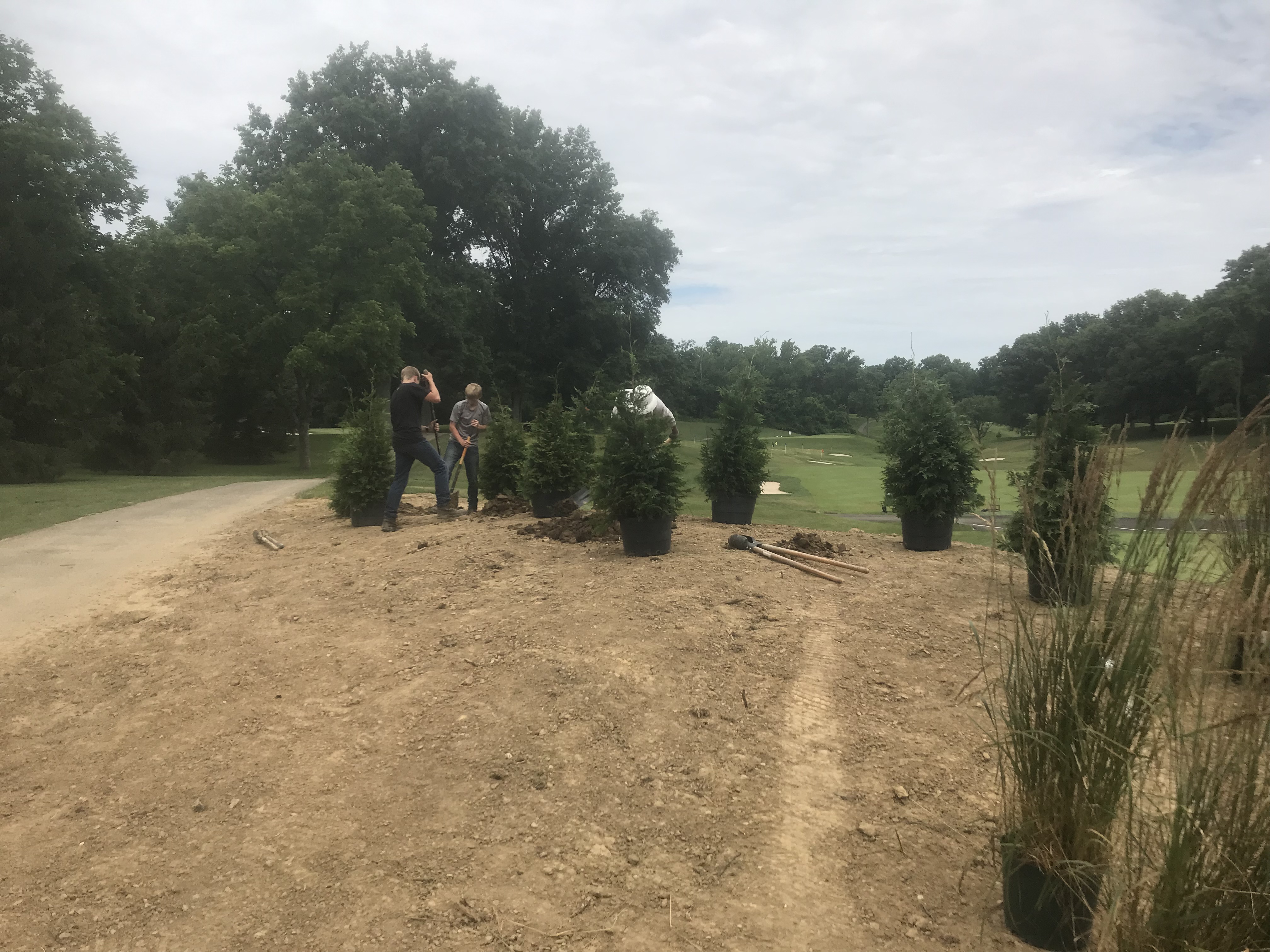
The finishing touches on phase 1 of the driving range are nearing completion. Plants were installed above the new chipping green to keep golf balls from entering the new practice area from tee shots on #6. Plants chosen were spring grove arborvitaes, blue pacific junipers, and feather reed grass. The arborvitaes will eventually get 25' tall and the other plants will fill in with the goal of making an aesthetically pleasing, low maintenance landscape bed that keeps golfers safe. 

Matthew, Michael, and Mark installing spring grove arborvitaes.

Completed landscape bed

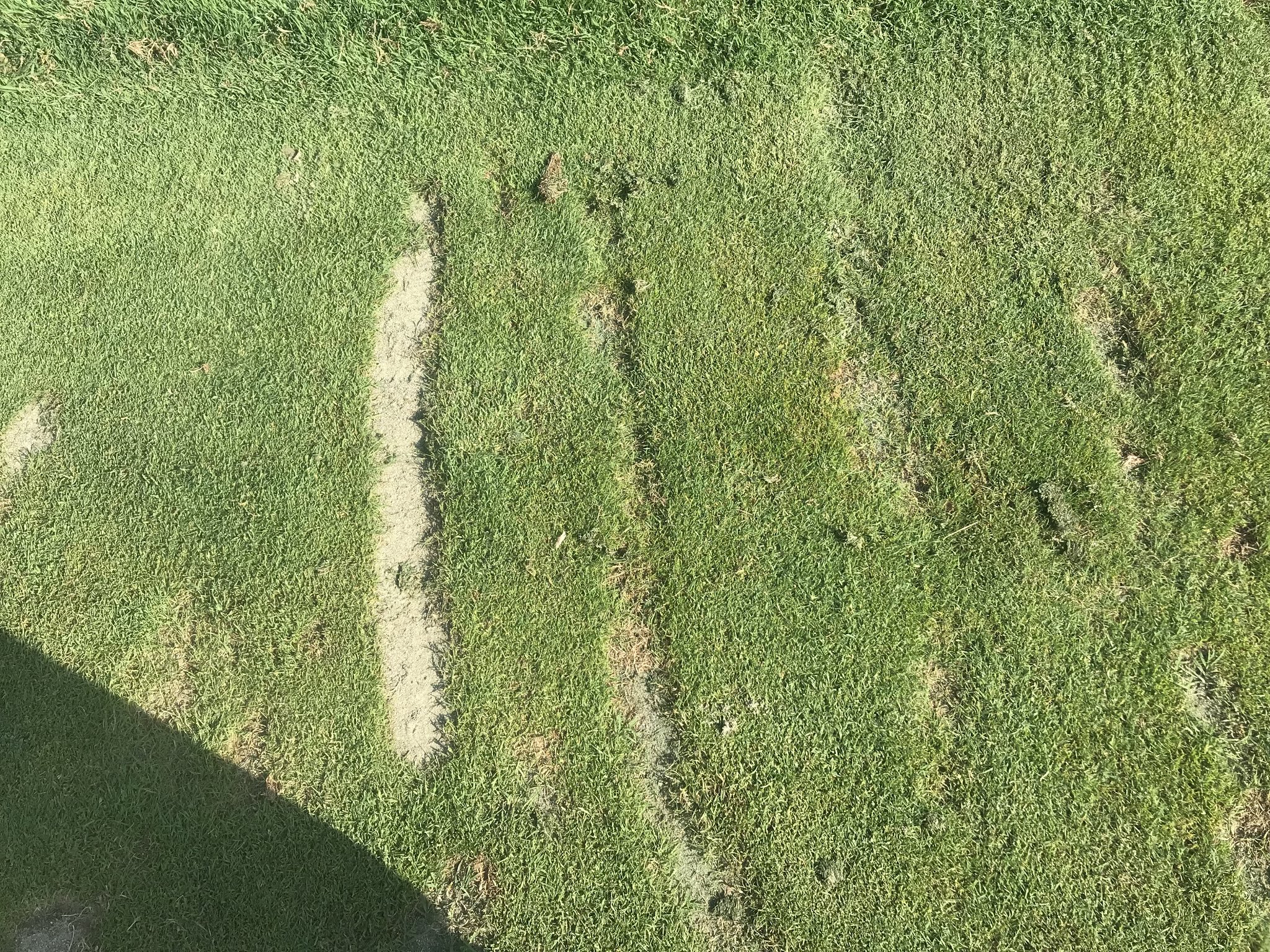
Everyone is excited about using the new driving range tee. However, the increased amount of practice has already beat up the tee considerably. A friendly reminder to hit practice shots in long, straight, linear patterns. Big chunks taken out will take much longer to heal than skinny straight line divots. Also, we have switched the driving range tees to utilize the north tee before construction occurs on phase 2. This will slow down the damage and give the new tee a chance to heal before the member/guest tournament. Once switched back, the new tee will be used for the remainder of the season.

Good divot patterns on practice tee

The same divot pattern three weeks later. Notice how quickly the creeping bentgrass fills in. The seed from the divot mix combined with the creeping nature of the bentgrass on the sides helps speed recovery.

Bad divot pattern. It will take a longer time to fill in these big chunks.


Over the last couple of years small wasps have begun to buzz around some sand bunkers. They are smaller than the usual suspect, the cicada killer wasp, but tend to look almost identical. I'm not an entomologist, but my best guess is these are sand wasps (Bicyrtes quadrifasciatus). Joe Boggs, Ohio State Extension entomologist, wrote an article about these wasps a couple years ago when he found them at White Oak Garden Center (click here for the article). They feed off of brown marmorated stink bugs and are also named stink bug hunters. Like cicada killers, they are solitary wasps that are not aggressive and rarely sting. They dig burrows into sandy soils, making bunkers a perfect environment. Chemical control is difficult because the wasps are scattered out into many different burrow colonies. Daily raking of the bunkers helps to keep the populations down, but are extremely difficult to fully eliminate. We have made some pesticide applications; however, they eventually resurface. Sand wasps are technically a beneficial insect, and are not a threat to stinging humans. We will continue to frequently rake the sand traps, and if this year is similar to the past, they will eventually move on.


A few trees were planted around the course. A river birch was planted behind #14 green in memory of Dr. Tom Burch. A red oak was planted by #17 red tee to replace the adjacent dying pin oak. And an espresso Kentucky coffee tree was planted next to the lightning struck tree by #9 green that is slowly succumbing to last year's lightning damage. Also, the high school kids have been a big help this summer. One of the projects they are working on is cutting back the fence lines along #11, #12, and #16 cart paths.

Planting Dr. Burch's memorial tree

Trimming back #16 fence line


Phase 2 of the driving range project is quickly approaching. The landscaping at the new cart building and installation of a new gravel cart path parallel to the building will be the next projects up. Meanwhile, the grounds department has come to the conclusion that the answers to our problems are definitely NOT blowing in the wind!


Brad Piecuch

Grounds Superintendent