Friday, August 19, 2022

Cooling Down

 As we head into the final stretch of the summer season, the agronomy team feels a bit like Luke, (Paul Newman) in the famous Cool Hand Luke fight seen, after dealing with this year's summer weather extremes. In the movie, Luke gets into a fight with a fellow prisoner, Dragline, who is much bigger than him. After getting pounded by the bigger opponent, Luke refuses to give up and after Dragline becomes bored and uninterested, Luke still rises up and refuses to quit even though he is physically and mentally exhausted. 

This year, Mother Nature has done its fair share of beating on the cool season turf. After one of the wettest months of May on record, late June ushered in little to no moisture. This was followed up by an extremely hot July with high humidity (actually according to the national weather station in Wilmington, OH we have double the number of hours at or above 70-degree dewpoint readings this year)

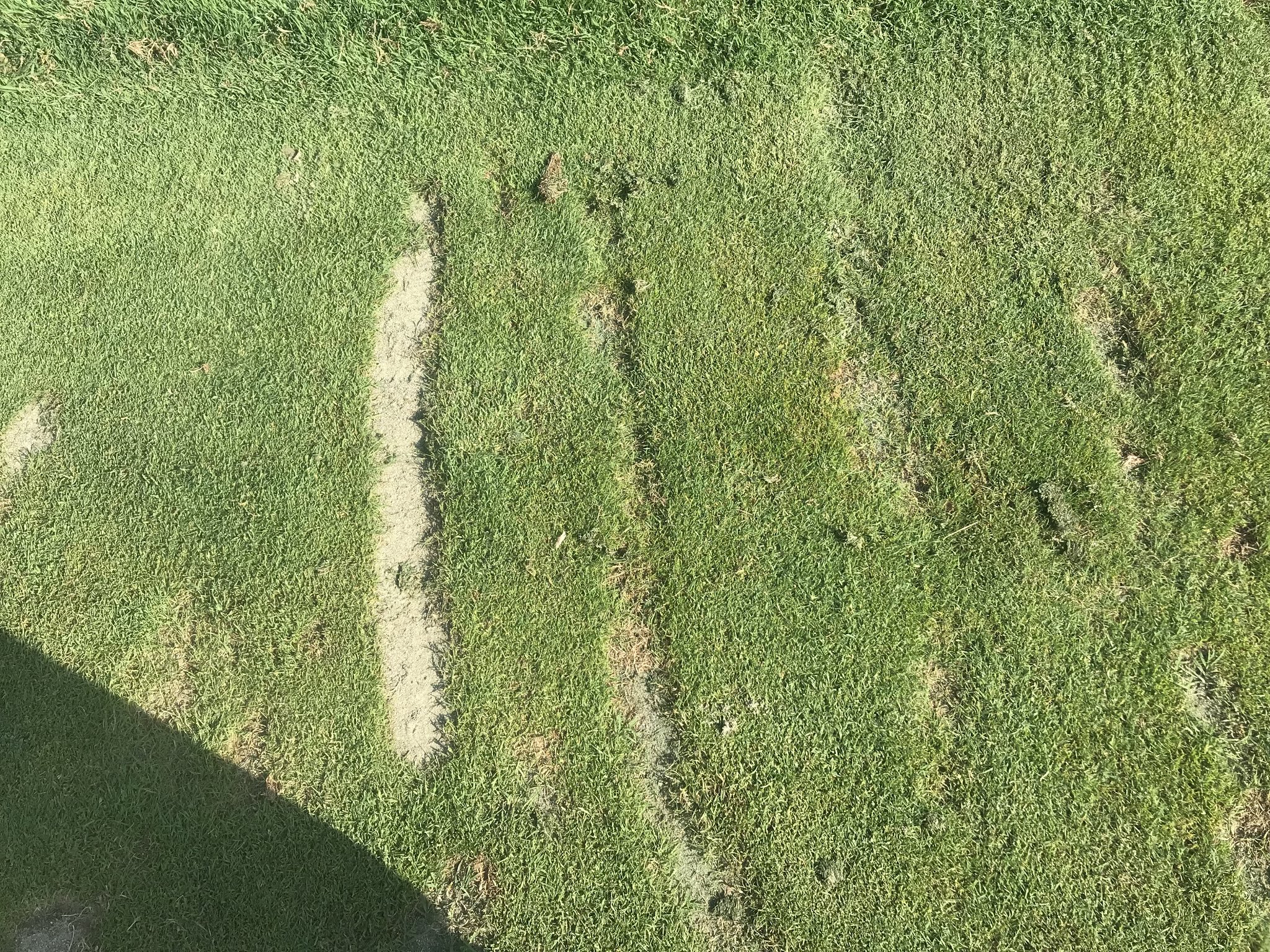
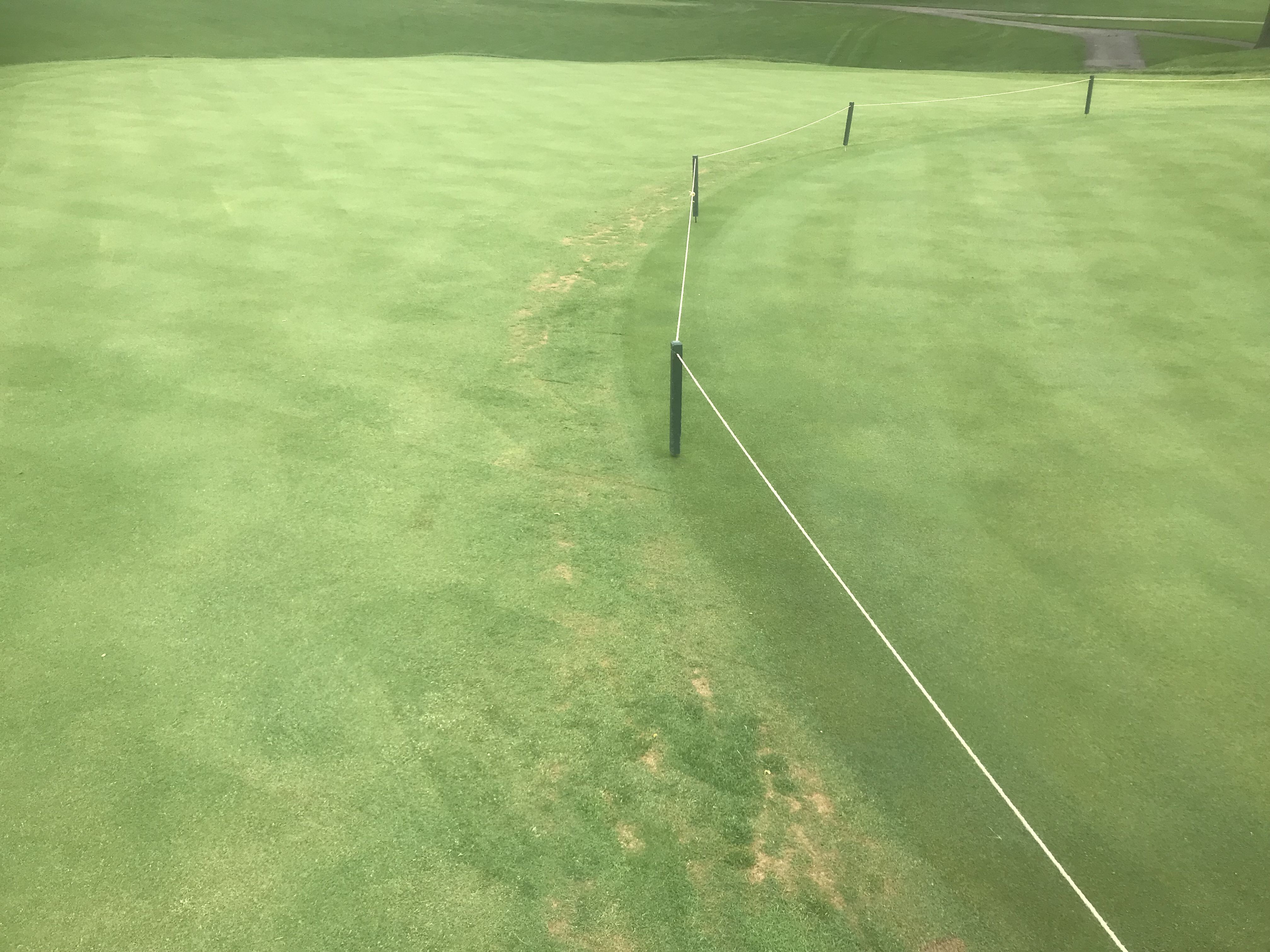
Extremely wet, followed by dry, followed by hot and humid, really rocked the bentgrass/poa annua fairways. By the last week of July, the extreme weather patterns had taken its toll and some patches of poa annua tapped out- poa annua is a winter annual grass that dies during hot temperatures. Most of the areas were on fairway perimeters that are also fighting with tree roots for nutrients and moisture. To combat this we aerated, seeded with bentgrass, and fertilized those patches. Luckily, so far August has had near to below normal temperatures and the brown areas are starting to recover; however, hotter temperatures may be returning in the next week.

It cannot be overstated that one of the main reasons we have an abundant amount of poa annua on the course is because of the numerous large and mature trees that continue to get bigger and produce more shade. Annual bluegrass (poa annua) thrives in shade and there is a direct correlation between increasing shade and more poa annua (don’t just take my word for it-here is an article by the USGA on increased poa populations due to shade) 

Many golf courses around the area have realized this, along with other negative turfgrass effects caused by mature trees and embarked on major tree removal projects (here is a case study done by the USGA on tree problems and removals). Please understand that as long as a significant amount of annual bluegrass exists on playing surfaces there will always be some dead turf during extreme summer weather stretches, with some years being worse than others. 

The agronomy team will do everything possible to keep it alive by applying adequate moisture, using wetting agents, administering aggressive fungicide spray applications, and executing sound cultural practices; however, Mother Nature has the final say on how much turf will make it through a particular Ohio Valley summer. 

Left of #9 fairway on August 1st.

Same area on August 19th. It is recovering.

Solid tine aerating practice tee and bad fairway areas.


Tree roots negatively impacting the fairway turf on #7. This is a double edge sword with trees promoting the growth of more poa annua during the cooler months and at the same time causing an increased amount of summer stress to the turf by winning the battle for moisture and nutrients.

Same area in August 2019. This is an annual occurrence.


The projects are in full swing again at WHCC. The new cart barn is finished, and the Grounds Crew installed new landscaping and built in a cart path parallel to the building. There is a white oak tree that is in declining health due to half its roots being excavated for the building installation and soil being mounded up over the critical root zone. After this is removed, we will cover up the mounds with new fescue sod. The landscaping consists of river rocks and ornamental grasses to keep maintenance at a minimum. Window boxes were added to the front to give the building some color.

Digging in the new cart path.


Positive drainage and rock added to the front of the new building.

Cart path and landscaping completed on the back side. Next up is the removal of the white oak tree, shaping, and sod.

The completed front of the new cart building.

Phase 2 of the driving range project is underway. A new 9,000 sqft driving range tee will be built above the existing north tee. A new cart path will be cut in over the old dump site and end above the new practice tee. This is a smaller project than phase 1, but it still has a decent amount of work attached. After the area is shaped, drainage will be added, irrigation moved and new pipe and heads installed, fescue seed put down on the construction site with futera matting to hold it in place, and the new tee seeded with bentgrass. Then watering, fertilizing, and waiting for the germination process begins. Hopefully we are done with the shaping and seeding by mid to late September, but this is very much weather dependent.

Tree excavation.


Extending 18" draintile to accommodate the new cart path.

Brian Huntley's phase 2 design.

The cart paths are in need of some repairs. The Green Committee highlighted areas that are in need of the most restoration. This will be accomplished the week of August 21st. #6 cart path will be repaired after the driving range project is completed.

Areas in blue will be fixed. #6 cart path, shown in yellow, will be fixed after projects are completed.

Irrigation leaks are occurring with more frequency this season. Perhaps the, now 11-year-old, system is starting to show its age. The leaks are happening in different locations. We are fixing them as time allows. 

A fixed pipe that was leaking at the 22.5-degree elbow by #13 tee


Assistant Superintendent Mike Westendorf fixing a broken case on a #1 fairway irrigation head.

Fixed broken tee joint on #17 fairway.

A couple heavy rain events during late July and early August caused washouts in the over 20-year-old bunkers. Once this occurs, topsoil from the surrounding area gets mixed in with the sand, negatively impacting the sand's consistency. Currently, we are talking with the Green Committee on possible solutions and hopefully, once the projects subside, we can work on a couple problem bunkers by excavating the sand and installing new draintile. However, this will only be a short-term fix and we need to address long term solutions.

#8 green side bunker holding water 2 hours after a heavy rainstorm.

Bunker on #9 green holding water and soil.


Soil accumulating in the bottom of #4 fairway bunker after a rain event


Soil washing out into the middle of #10 green bunker. Still holding on to a bit of water an hour after a recent rainstorm.


The pin oak tree close to #9 green finally succumbed to last year's lightning strike. This was removed on August 15th. The pin oak that split during the June thunderstorm and the white oak by the new cart building will be taken out on September 6th.

The pin oak by #9 green before removal. Over 50% of the canopy was lost.


On the horizon is the aerification season and the greens are set to be core aerated on September 6th. The tees, rough, driving range tees, and fairways will follow. I will continue to update as the projects, maintenance, and whatever else Mother Nature throws at us, progresses. As the temperatures start to cool down, the Grounds Department would like to thank the membership for their continued support through the summer season and we are looking forward to the completion of the fall agronomic and facility projects that will enhance the beautiful WHCC golf course and landscape!


Brad Piecuch

Grounds Superintendent


Wednesday, July 13, 2022

Midsummer Update

There is only one four letter word that is banned on the Grounds Department. It causes more work for us than most all other weather phenomena combined and is only rivaled by the once in a decade ice storm. Like the word "Beetlejuice" I hate to even mention it, for if said enough it may appear to wreak havoc on the course again! It is Wind!

Two recent wind storms in particular caused a tremendous amount of debris. One on June 21st and another on July 6th. There have been some questions as to why we must shut down the golf course after storms that produce minimal precipitation. The answer is, the number of small limbs, leaves, large branches, and garbage that these windstorms produce causes, in most cases, a whole day's work or more to clean up. During the June 21st storm a pin oak with a tight bifurcation (double trunk tree) split at the branch intersection and took a whole day to cut up and remove. Small branches, from ovipositor cicada damage, fall with regularity and with a strong wind are intensified. Leaves and twigs must be blown off high trafficked areas (greens, tees, fairways) and either chopped up or picked up. Chain saws must be used for bigger limbs with firewood stacked and small debris taken to the dump areas. Of course, all of this work replaces the daily maintenance schedule and pushes us behind on much needed mowing, watering, rolling, and spraying. Please understand that areas have to be cleaned up before daily grooming can occur to get the golf course into playable conditions that meet expectations.

Debris from the July 6th thunderstorm

Right of #10 cart path

#13 fairway

#8 fairway

#18 green

Garbage and debris next to #13 cart path

White pine limbs down on #15

#7 fairway

#15

Honey locust limbs by #18 cart path

Pin oak with bifurcation trunks split during the June 21st storm. This tree will need to be removed soon.

Co-dominant leader that split. This picture doesn't do the size justice. It took almost a whole day to cut up.

Close to the wettest May on record followed by a dry June has stressed out some of the turf on the golf course. In May, the heavy amount of rainfall favored many of the summertime diseases. To combat this, we increased the spray frequency and did a decent job keeping the turf disease free. In June the weather flipped, and dry, hot weather took over. Judicious watering, both using the irrigation system and hand watering have kept the turf alive at the mid-way point of summer. However, the toughest time of the year for the cool-season grass is in full swing and some turf will be lost even with sound agronomic management (For those interested click here for an informative video from Ohio State on current Ohio turf conditions).

At times it will be necessary to limit the number of carts in the fairways and use the ninety-degree rule-carts travel onto fairways only at 90 degree angles from cart paths or rough- when entering and exiting during days of extreme heat (close to or over 90° F). On these days the bentgrass is so stressed that simply driving over it can cause severe damage. This type of injury usually occurs during the middle of the day when the sun is at its peak and the temperatures are the highest. Limiting cart traffic to the path and rough during these times will greatly help improve fairway conditions.

°
Cart traffic damage on #18 fairway after driving over the turf during the hottest time of the day.

The finishing touches on phase 1 of the driving range are nearing completion. Plants were installed above the new chipping green to keep golf balls from entering the new practice area from tee shots on #6. Plants chosen were spring grove arborvitaes, blue pacific junipers, and feather reed grass. The arborvitaes will eventually get 25' tall and the other plants will fill in with the goal of making an aesthetically pleasing, low maintenance landscape bed that keeps golfers safe. 

Matthew, Michael, and Mark installing spring grove arborvitaes.

Completed landscape bed

Everyone is excited about using the new driving range tee. However, the increased amount of practice has already beat up the tee considerably. A friendly reminder to hit practice shots in long, straight, linear patterns. Big chunks taken out will take much longer to heal than skinny straight line divots. Also, we have switched the driving range tees to utilize the north tee before construction occurs on phase 2. This will slow down the damage and give the new tee a chance to heal before the member/guest tournament. Once switched back, the new tee will be used for the remainder of the season.

Good divot patterns on practice tee

The same divot pattern three weeks later. Notice how quickly the creeping bentgrass fills in. The seed from the divot mix combined with the creeping nature of the bentgrass on the sides helps speed recovery.

Bad divot pattern. It will take a longer time to fill in these big chunks.


Over the last couple of years small wasps have begun to buzz around some sand bunkers. They are smaller than the usual suspect, the cicada killer wasp, but tend to look almost identical. I'm not an entomologist, but my best guess is these are sand wasps (Bicyrtes quadrifasciatus). Joe Boggs, Ohio State Extension entomologist, wrote an article about these wasps a couple years ago when he found them at White Oak Garden Center (click here for the article). They feed off of brown marmorated stink bugs and are also named stink bug hunters. Like cicada killers, they are solitary wasps that are not aggressive and rarely sting. They dig burrows into sandy soils, making bunkers a perfect environment. Chemical control is difficult because the wasps are scattered out into many different burrow colonies. Daily raking of the bunkers helps to keep the populations down, but are extremely difficult to fully eliminate. We have made some pesticide applications; however, they eventually resurface. Sand wasps are technically a beneficial insect, and are not a threat to stinging humans. We will continue to frequently rake the sand traps, and if this year is similar to the past, they will eventually move on.


A few trees were planted around the course. A river birch was planted behind #14 green in memory of Dr. Tom Burch. A red oak was planted by #17 red tee to replace the adjacent dying pin oak. And an espresso Kentucky coffee tree was planted next to the lightning struck tree by #9 green that is slowly succumbing to last year's lightning damage. Also, the high school kids have been a big help this summer. One of the projects they are working on is cutting back the fence lines along #11, #12, and #16 cart paths.

Planting Dr. Burch's memorial tree

Trimming back #16 fence line


Phase 2 of the driving range project is quickly approaching. The landscaping at the new cart building and installation of a new gravel cart path parallel to the building will be the next projects up. Meanwhile, the grounds department has come to the conclusion that the answers to our problems are definitely NOT blowing in the wind!


Brad Piecuch

Grounds Superintendent


Wednesday, June 8, 2022

Whacking Away!

 Growing up one of my favorite games to play at the arcade was Wack-a-mole. The game consisted of moles popping out of random holes and the player would try and "Wack" as many moles as possible before time expired. Every time you thought you whacked them all, inevitably another one would surface. Currently, the grounds department is playing their own version of whack-a-mole called whack-a-project. Every time one project is accomplished another one will pop its head. 

First up for the WHCC construction team has been phase 1 of the driving range projects. I'm happy to announce that after 1,284 in-house man hours, the opening of phase 1 is only days away.  The chipping green, approaches, and new driving range tee all look healthy and are ready for daily play. However, the putting green expansion, especially the transition area, needs more time to heal in. The late seeding date combined with many washouts have caused uneven drainage pockets that have held on to water leading to some scorched areas along with mower damage from mowing over the uneven surface. We are trying to decrease the wear patterns by skipping the cleanup round in the transition area and using rubber mats for turning but I do think we may have to address the unevenness with some excavation this fall. In the meantime, the transition area will have to be roped off until the grass can completely heal in. We plan on opening the bottom half of the putting green for bump and run shots on the June 15th opening date. Please understand that both the new putting green expansion and chipping area will take some time before they begin to roll as fast as the rest of the greens on the golf course. The turf is still in its infancy state and cannot take the lower mowing, continuous rolling, frequent topdressing, and heavy plant growth regulator applications like the older greens. Eventually we will get them there, but the grass will dictate how aggressive we can be in the short term.
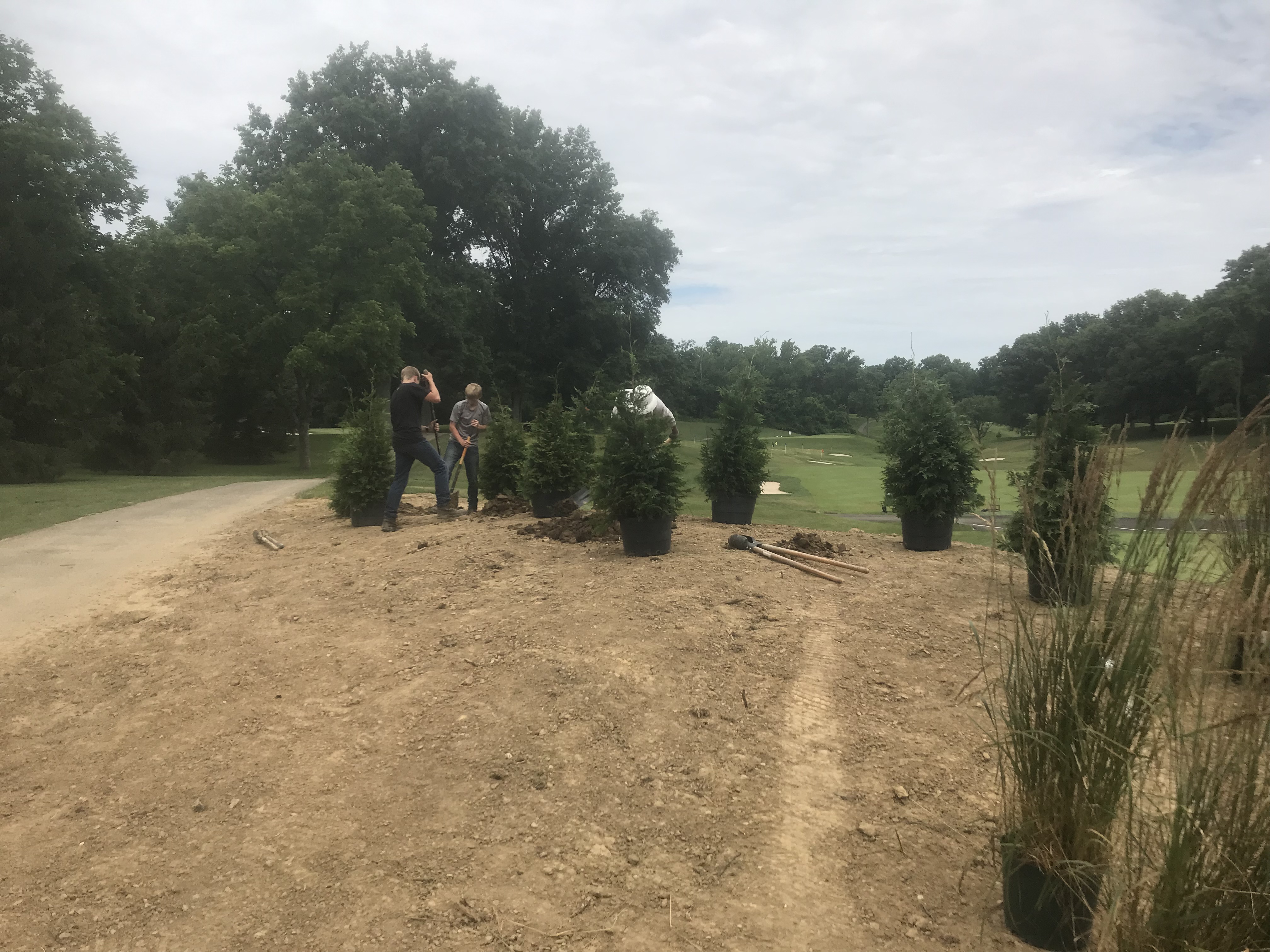

The transition area of the new putting green expansion. We are decreasing the topdressing applications and keeping wear patterns down to try and help it heal in.


 Innovation zoysia grass has been installed on the target greens in the driving range. This grass was selected because of its drought tolerance, disease resistant, and heat loving attributes. Also, it is a newer variety with the coldest hardiness of all southern type grasses. Zoysia grass does not have the aggressive creeping nature of Bermuda grass so there are no worries about it taking over the entire driving range floor. During the colder months the target greens will be a light brown color that should be very noticeable against the green backdrop of the cool season grasses.

Sodding is the best way to establish this turfgrass and there are only two local companies that have it available. One is in Evansville, Indiana, and the other is the Southeastern Turfgrass Research Center in Lexington, KY. We went with the Lexington distributor and Dr. Mike Harrell is the owner. They are on the front lines of new and improved turfgrass varieties. 15,000 sqft of innovation zoysia sod was delivered over the weekend. It was a day and a half project in between monsoons, but we did get all the target greens stripped and resodded. The new zoysia grass will take some time to root in and once it does, we will be mowing it at tee height and this should enhance the target green perimeters.


The innovation zoysia field in Lexington KY

Section the new turf was cut from

Innovation zoysia arrives-43 rolls.

Stripping of old target greens

Laying out new zoysia


New target greens after installation. The target greens will be mowed at tee height once the sod is established


The chipping green surrounds have many wet pockets because of cutting into the existing hillside. We have fixed two of the 5 wet areas with new perforated drain tile and backfilling with sand. Some of the wet areas may need the work of an excavator and will need to be accomplished during phase 2 this fall. Any wet areas that we do not rectify will have signs to notify golfers.

Miguel and Raymond taking on a wet area

Miguel digging a new drainage trench

The old cart path on #5 has been eliminated and Russ Mackee used the excess dirt from the new golf cart building to fill it in. It has been seeded and is currently filling in.


The new patio expansion is complete and will be a great addition for outdoor dining. The drainage work done around the putting green left a good size trench that needed to be filled in and sodded. We completed the finishing work a couple weeks ago and we are now trying to keep the sod watered and alive in the summer heat.

Jason and Mark leveling out the old soil.

Next up will be the landscaping on top of the chipping green hillside. We will be choosing plants that will block golf shots from hole #6 without getting too tall to shade out the new chipping green.

New landscaping to be installed in the next weeks

Meanwhile, on the golf course we have been in full spray mode trying to stay away from the summer time diseases. The mowing crew is out in full force and it has been a challenge to keep up with cuttings in between the rainstorms. Also, the annual bluegrass weevil has reared his chewing head again and we are making insecticide applications to minimize its impact. We will spray a couple more insecticide applications to kill off future generation that will try and emerge this season.

ABW larvae found by #7 green

Close up of ABW

Zach Nicoludis, the regional USGA agronomist, dropped by WHCC for a consultation. Many topics were discussed including, trees, putting green and tee maintenance, bunker management, the new driving range project, thatch reduction in the fairways, and labor. He will write a report about recommendations, and I will share it with membership once completed. The visit went very well and many of his past recommendations have been followed. In particular, his recommendation on frequent and light topdressing has yielded positive results with firmness and green speeds.

Light topdressing of #3 green

On the horticulture side, the installation of the summer annuals is almost completed. There are a few new annuals that were used this season. The back patio pots have, as their focal points, majesty palms and one gardenia. The gardenia is a southern plant that is very fragrant, and the majesty palms give off a tropical feel. Birds of paradise were used next to the oak room entrance and celosia should give a different look next to the putting green.

Gardenia flower. Very fragrant

Birds of Paradise

The Delhi area has the nickname of "Floral Paradise of Ohio," and for good reason. At one time there were approximately 60 operating greenhouses in Delhi, now there are around 6. Here at WHCC we are trying to keep this nickname alive by purchasing our annuals from western hills distributors and taking pride in our horticulture program to help keep the West Side the "floral side" of Cincinnati. I came across this video a couple years ago made in 2000 about the history of greenhouses in western hills. It is interesting to learn about this area’s rich history with horticulture!
Here is a link to the video-click here


As we get deeper into the summer season the grounds department will remain busy with golf course maintenance and the beginning of phase 2 of the driving range project. In the meantime, we will be looking for a bigger whacking mallet!

Brad Piecuch
Grounds Superintendent