Saturday, April 30, 2022

Around the Grounds-May

The Champion overcup oak lit up at night.

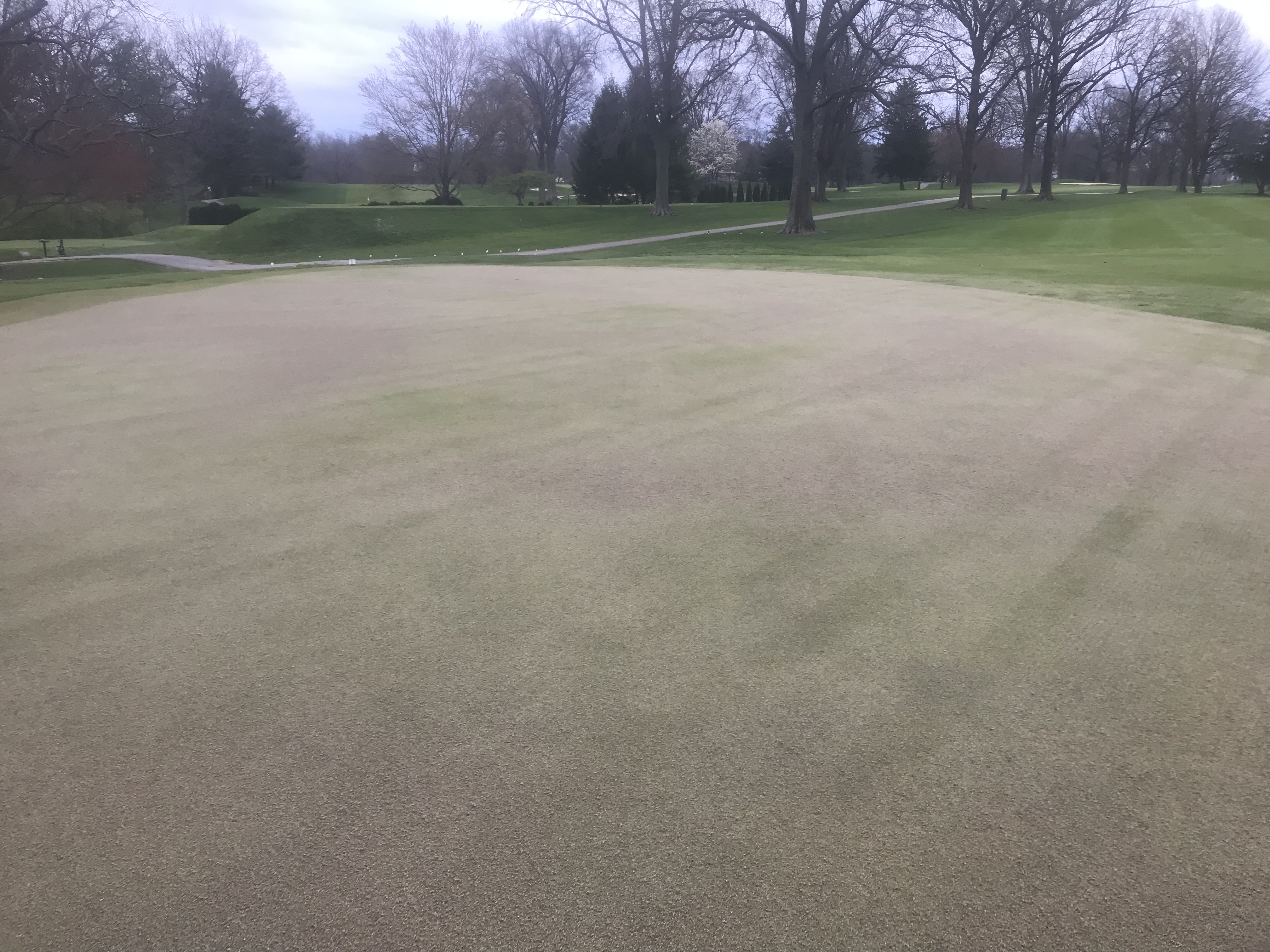
 As we close the book on April and move into May, the agronomy team is looking forward to warmer temperatures. Late March and April have been colder than normal hindering many of the grow in projects. The far (north) driving range tee is opening on Sunday May 1st; however, the floor of the driving range is still in the process of germinating and will need more days of warm temperatures to fill in. One thing I have learned through phase 1 of the driving range project is the importance of seeding in August or September. Every area seeded in that time frame has come out of the winter with nice coverage and healthy turf. The areas that were seeded in mid-October into November have less germination, thin turf, and much more growing to accomplish. 

Spring seeding is less effective than early fall. 1 to 3 is a good ratio when thinking about the difference in seeding. 1 week of germination in the fall equals 3 weeks to accomplish the same amount of germination in the spring. This is because the soil temperatures are very warm in early fall but take much more time to warm up after the cold winter. Since the driving range floor was seeded in early November, the turf is very thin, and the seed planted a month ago is just starting to grow. The grass should continue to fill in as we head into late spring and summer, and in June we will be sodding all the target greens with innovation zoysia (more on that on a later post). 

The putting green expansion was seeded in early October and is starting to fill in but is still behind the progress of the chipping green that was planted in late September. We will continue to water and fertilize to push growth and hit the target opening dates but understand the quality of these surfaces will take some time to mature before they are able to take the daily abuse of regular play and meet current green speed benchmarks.


Floor of the driving range in late April

Notice the left side of the floor. That was planted in November and needs time to fill in.

New driving range tee. Seeded in September and looks great in April.

The greens maintenance program has begun with regular topdressing, PGR applications, mowing, rolling, and verticutting taking place. The greens are scheduled for solid tine aeration on Monday, May 2nd. A contractor is used to deep-tine aerate (10" deep) the putting surfaces, and this will take all day to accomplish. We will heavily topdress after aeration to fill in holes and smooth out the surface. This is a much-needed cultural practice that reduces organic matter, helps drainage, and decreases compaction. The bottom line is to have healthy, firm, and fast greens this needs to be accomplished at least twice a year. The green speed will be slower for a week or so but will steadily increase as the greens heal. Click here to read a USGA article on aeration!

A green after verticutting. This encourages horizontal growth, decreases thatch leading to faster and firmer greens.

Topdressing at 2 cuft/1,000 sqft. Frequent light topdressing smooths out greens and helps firmness.

2nd assistant Chris "Wheels" Wheeler verticutting #5 green.

 
USGA illustration of the benefits of aeration


We have received some questions about the cup changing process. The putting green cups are changed during the golf season 5 times a week. The number 1 concern with changing hole locations is to decrease wear on the greens. If cups were kept in the same location for many days the area around the cup would become compacted, stressed, and eventually die. The cups need to be rotated in order to spread foot traffic to different areas. Also, it creates different putting reads for different hole locations.

We use a 9-grid pattern for selecting pin placements, with flag colors consisting of red for the front, white for the middle, and blue in the back. If hole number 1 is in the 3 spot, hole 2 would be in the 4 spot, hole 3 would be in the 5 spot, and so on (see diagram below). There are specific holes where a hole location cannot be used (left of the middle of three green is an example). For these locations we move the cup as close as possible to the grid hole location without making it an impossible putt. Some people like aggressive cup placements and some prefer locations to be in the easiest spot possible. There have been many occasions where on the same day golfers will approach me and applaud the cup placements, and 5 minutes later other golfers will comment on the "horrendous" hole locations. Keep in mind WHCC has small greens and to properly space out foot traffic sometimes we do have to be aggressive on pin placements. We try and keep holes off of slopes, but sometimes mistakes are made especially when training new employees. We will strive to keep the cups fair and the turf healthy.

9-grid cup changing pattern. Locations are moved in order daily. For example, if hole 1 is set in the 2 spot the next day it will be in the 3 spot, and the next day 4 spot, and so on.

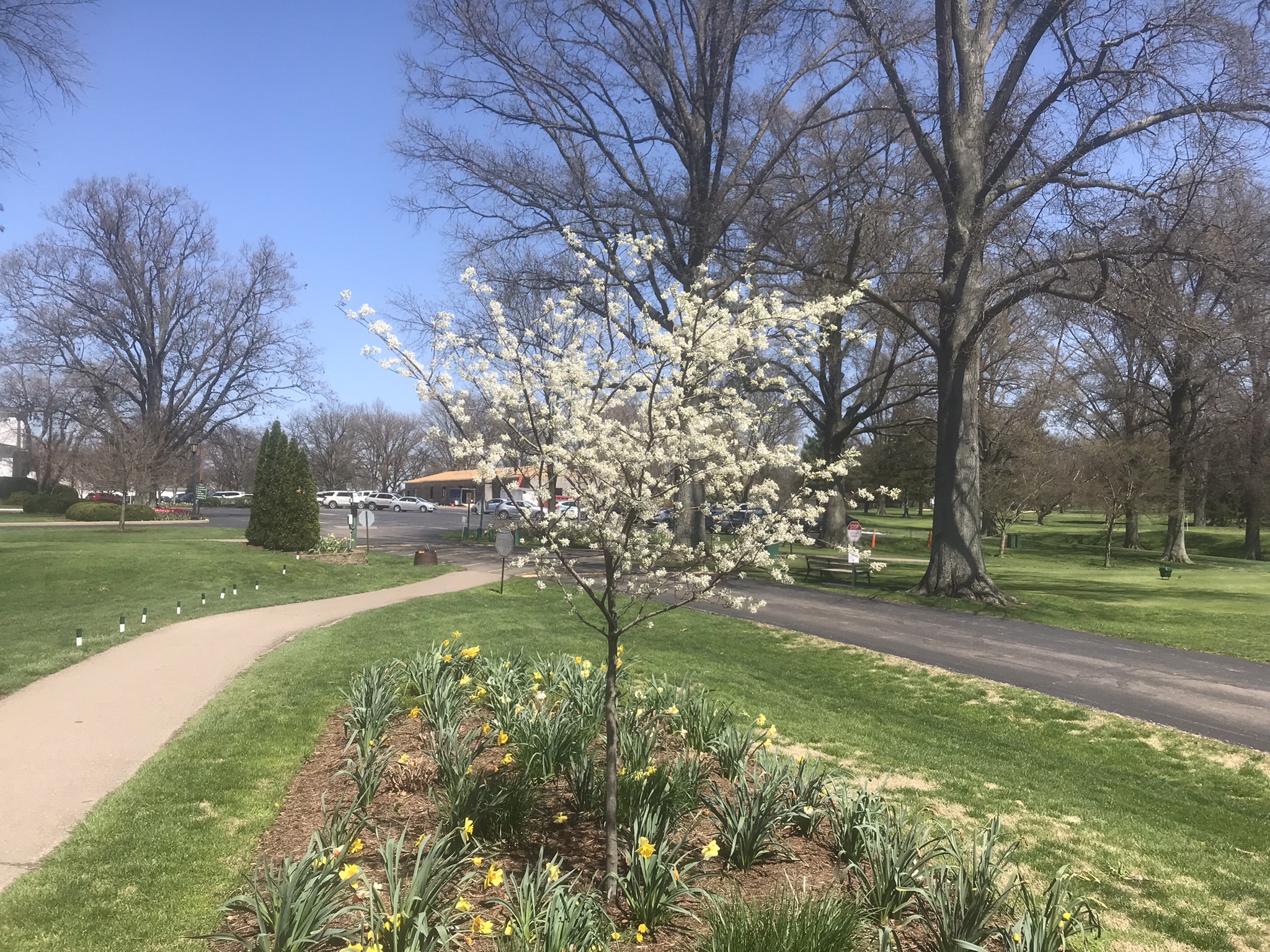
2007 was the first year the tulip display was planted with 200 bulbs under the red oak tree. Today it has grown to around 5,000 tulips. It is always a beautiful site to see them in full bloom around Easter. Along with the tulips the grounds are home to many other spring blooming plants. WHCC has thousands of daffodils (that are deer resistant), hyacinths, and many other flowering trees and shrubs. This provides a cornucopia of spring flowers for people to enjoy. Soon the spring display will give way to the summer annuals. Here are a few pictures of the spring flowers.


Finally, some trees are getting treatments for diseases or other stressors. 4 blue spruce trees (3 by #7 green, 1 by the clubhouse) are getting treatments for rhizosphaera needle cast disease. This is the disease that has killed almost all the blue spruce trees on the grounds over the last couple of years. These treatments consist of trunk injections and foliage sprays and have saved many blue spruce trees around the area. There are no guarantees but hopefully the fungicides will keep them alive. Also, the pin oak by #9 green, that was hit by lightning last year, is being treated with fertilizer applications, fungicide injections, and insecticide sprays to try and save it. This tree was recommended for removal, but there is a chance, with these procedures, it may recover and we will continue to monitor. The last tree treated is the pin oak by #17 red tee. It blocks many shots from hitting houses. It has a ganoderma infection, which is not curable but can be minimized extending the tree’s lifespan. We will be planting a tree behind the pin oak to take its place after the disease eventually runs its course.

ArborFos trunk injections for needle cast disease on a blue spruce by #7 green.


As we enter the busy golf season the majority of our time will be devoted to daily maintenance. We are navigating the tough labor market like many other departments and industries. To say it has been tough to find employees would be an understatement. Luckily, the grounds department has many talented and loyal workers who are picking up the slack to keep the course and grounds in good shape. We will continue to navigate these rough times and hopefully the end of the school year will provide us the help we need!


Brad Piecuch
Grounds Superintendent


Tuesday, March 29, 2022

Spring Happenings

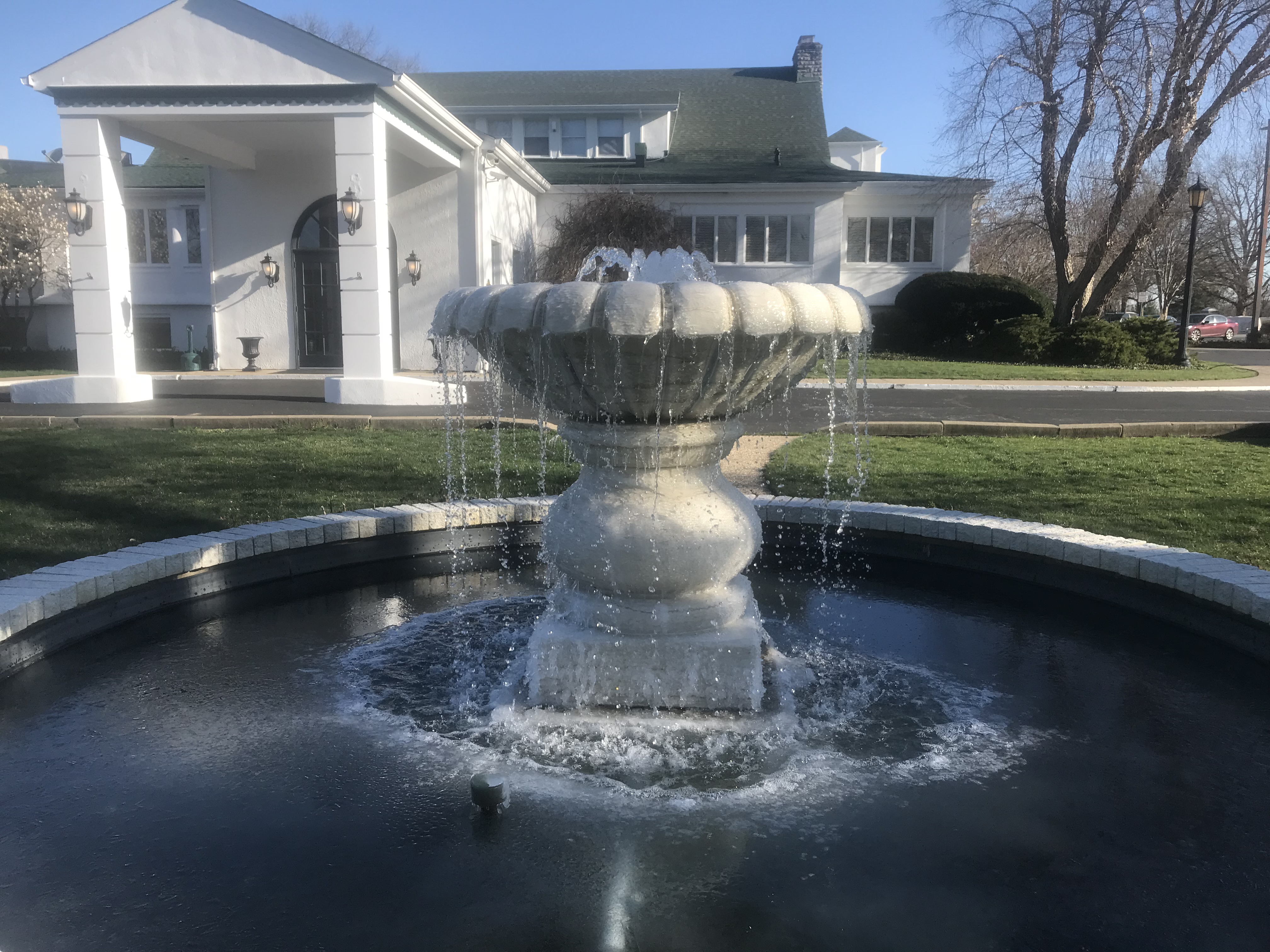
Cold late March temperatures freezing the newly turned-on clubhouse fountain

Spring is here and the Grounds Crew is busy getting the golf course ready for the season. The temperatures have been up and down; with the first part of the month well above normal and the latter half much colder. Mowing has begun on the putting greens, fairways, and tees. The rough should start to grow in early April. 

Verticutting of the fairways is underway. This will help decrease the heavy thatch layer that had accumulated over the years. Thatch is the buildup of organic material between the crown of the grass and the soil. It is composed of undecomposed rhizomes, crowns, roots and stolons. It binds up water and nutrients prohibiting its percolation farther into the soil profile. This causes moisture and roots to hold closer to the surface. Shallow roots and thick thatch lead to soft and wet fairways. Since we have started verticutting in the spring and deep-tine aerating in the fall, the fairway conditions are beginning to improve. The thick thatch layer is decreasing, and the roots are growing deeper into the soil profile. This has allowed us to cut back on irrigation leading to firmer conditions. Hopefully this continues and we will keep up with these annual cultural practices. 

Assistant Michael Westendorf verticutting #10 fairway

Verticutting and picking up debris with the TC-125 John Deere sweeper

Thatch from a #10 fairway plug in 2020. Puffy thatch and organic material are noticed above the red line

A soil plug from the same location on #10 fairway in March of 2022. The thatch is decreasing. 

Soil profile from #18 fairway notice the white roots extending below this core. Estimated at 8" deep.

The work on finishing phase 1 of the driving range project has begun. We pushed to get as much accomplished as possible before cold winter weather and decreased sunlight brought it to a halt. Over the winter, many areas of the driving range floor, on hillsides and at the low center,  washed out from water rushing through after rainstorms. To fix this we added a 12" catch basin below the 18" pipe that drains under the new practice tee. This is connected to 6" perforated drain tile that connects to existing tile. Also, swales were added to the center to help slow down and catch water before it washes soil and seed away. The ruts on hillsides were filled in and seeded. Target greens are marked, and we will soon begin to mow them at a shorter height so they can be seen. Now, warmer temperatures are needed for germination and, eventually, for the grass to fill in. Hopefully, we will be able to open the far tee and the driving range floor by the beginning of May.

Driving range floor in late February. Notice the long wash out occurring in the center.

Fixing the driving range floor

New catch basin installed in front of the 18" pipe that drains under the new practice tee.

Wilfredo and David laying sod around a catch basin located in the center of the range

Ricardo, David, and Jorge fixing ruts on the hillside.

Seed and futera matting added after soil leveled and prepped. Now we need warmer temperatures and moisture for germination.

The expanded putting green area and the chipping green are filling in. We have begun the process of mowing, rolling, fertilizing and topdressing, but these areas will need much more time to grow before they are ready for daily play. The tentative opening for these areas is June 15th.

First mowing of the year for the putting green expansion. It will take time to fill in and for us to begin to decrease the mowing height to match the other greens.

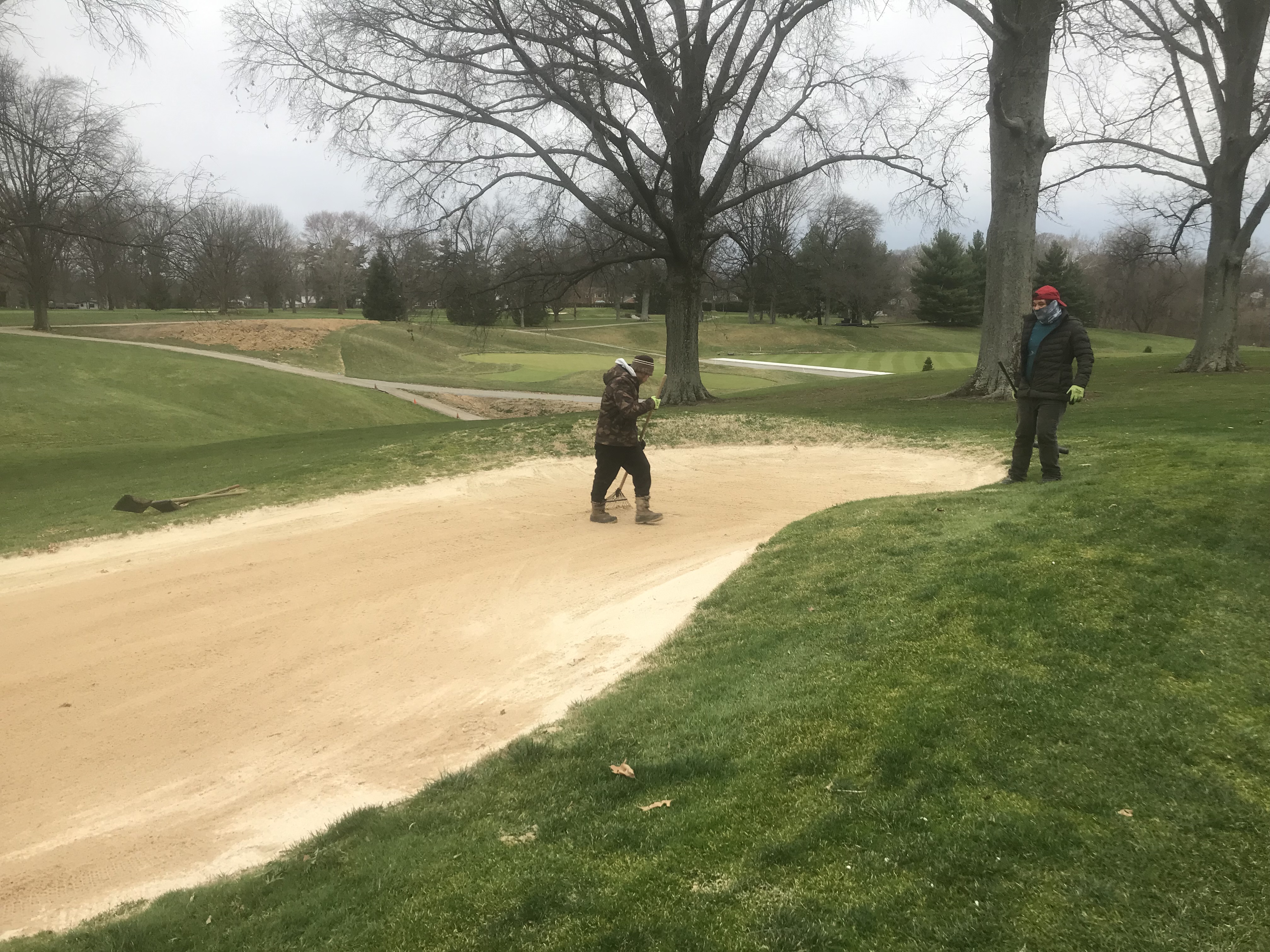
Bunker work is next on the list, and we have started adding sand to the bunkers that need it. We are measuring each bunker to try and keep 4 to 5 inches of sand in the bottoms and 2 to 3 inches on the sides. Understand that after rain events the consistency of the bunker's sand will change from the sides washing out and mixing in with the surrounding soil. Keeping the right amount of sand after washouts is very difficult (especially on steep slope faces) and I will be discussing with the Green Committee some possible solutions as the current project work winds down. Click here for more information from the USGA on bunker washouts.

Ricardo and Jorge adding sand to the left side #1 fairway bunker.

On the horticulture side, mulching of the landscape beds is underway. The proshop landscaping is completed with a new retaining wall built and new plant material installed. The plants consist of roses, ornamental grasses, hydrangeas, and dwarf lilacs. Something should be blooming in these landscape beds from late April until the first frost. The tulips will be in bloom in early April and there is a chance of the blooms extending into Easter Sunday.

Lemon zest roses by the wall and pink knockout roses in the back.

Pansies added in front of the verdin clock plaque


Miguel and Wilfredo trimming incrediball hydrangeas.

The warmer weather is right around the corner, and I will continue to update the happenings around the grounds as we move into the busy golf calendar. 


Brad Piecuch

Grounds Superintendent

Friday, February 11, 2022

Roller Coaster Ride

This winter has been a roller coaster ride for temperatures. After the 4th warmest December on record for this area, January ushered in below normal temperatures. Snowfall was scarce and the ground, especially greens, froze 6"+ deep. The turf went from a late March emerald green color in December, to a brown, frozen tundra by the beginning of February. Then we had a 3" ice/sleet storm that hit the grounds on February 3rd. This storm was a challenge to plow, since 3" of sleet is much heavier than the same amount of snow. We had to plow the lot 7 times to stay up with the precipitation so our bobcat could keep up with pushing the sleet. After working long hours for two days we were able to have the parking lot ready for members as soon as the roads were passable. 


#5 green looking like an ice-skating rink


Plowing during the ice storm


 The cold January temperatures allowed us to get much of the winter tree work accomplished. All of the limbs that the Green Committee suggested for removal have been eliminated. This will be noticed by many golfers this spring. It definitely opens up these holes for more aggressive shots. Most of the trees recommended for removal are taken down, and now we are beginning the process of grinding up the stumps, removing the grindings, filling up the holes with topsoil, and overseeding.


#9 tee area after limb removals

The grounds maintenance building is getting some much-needed upgrades. The lighting and heaters were installed in the mid 1980s and were malfunctioning. The 16 fluorescent lights in the back area were replaced with new flat panel LED fixtures. 12 fluorescent lights located in the mechanic shop, hallways, and break room were also replaced with flat panel LEDs. The old 200,000 BTU heater, that when turned on sounded like a bomb exploding, was replaced with a more efficient 250,000 BTU unit. This heater is much more effective and should save money on propane usage. In addition, the garage doors, and some other doors will be replaced. The drop ceiling will be lifted up in the back corner of the garage to accommodate a new lift that will be used to work underneath many of our heavy carts, mowers, and tractors. This will be installed once the new golf cart building is completed, and we have access to the existing cart wing for storage.

New flat panel LEDs on the right and the old fluorescent bulbs on the left. The old heater in the back.

New LED fixtures in hallways. I never knew that door was white!


New 250,000 BTU heater


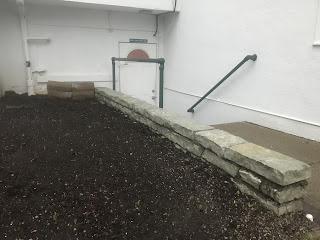
The railroad ties on #16 tee are being replaced with left over stone used for the pro shop retaining wall. We have had issues with golfers slipping on the railroad ties and this should eliminate that problem. Also, another retaining wall was built next to the walkway by the men's grill to keep mulch from clogging up the drain by the door after rainstorms.


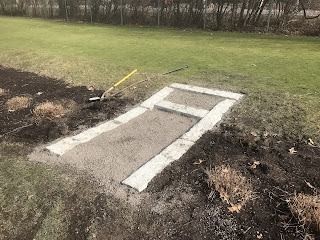
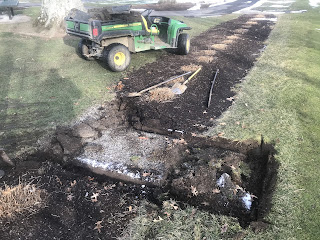
Replacing railroad ties on #16 tee


New retaining wall by walkway to men's grill

So far, the month of February has had below normal temperatures, but long-range forecasts suggest the latter half will be warm. Once the temperatures rebound, we will begin cleaning up the course and starting to prep for regular play. Dormant seeding will take place at the end of the month in all rough areas. Verticutting of fairways will, hopefully, start in mid-March but that is heavily weather dependent. The projects are currently on hold and the floor of the driving range needs to be completed as soon as mother nature cooperates and tentatively will begin sometime in March. Staff recruitment is underway, as we try to navigate the rough waters of this limited labor market. In the meantime, springtime temperatures are closing in, and the staff is ready for whatever roller coaster lies ahead!


Brad Piecuch

Grounds Superintendent


Saturday, January 15, 2022

Grounds Update- Infectious Diseases

 One thing working in this industry for the last 20 years has taught me is humbleness. Every time you think all things are under control, nature throws another curve ball. Spraying in late December and early January is typically not something that needs to be accomplished. Usually, temperature and humidity in winter are low enough to keep most diseases away. However, this year was the exception. The last week of December turned out to be the warmest I have ever seen for that time period. Christmas day we reached a record high of 69 and the week that followed had highs in the high 50s and low 60s with lows only a couple degrees lower than the daytime high. Also, it was extremely moist with heavy rain events and cloudy days that let the moisture and dew sit on the turf for the entire day. It was during this time that a disease popped up on the newly seeded areas. Greasy, circular patches with a white mycelium became evident and once noticed we quickly sprayed with different fungicides to contain it.

 I am not a plant pathologist, but superintendents have to play one every day they come to work. I speculated it was one of three diseases, take-all path, pink snow mold, or another outbreak of the damping off disease which we battled earlier in the season. We sent samples and pictures out to Mr. Todd Hicks, Program Director for the Turf Pathology Program at Ohio State. After looking at the sample he was unable to get the mycelium to act up, which is a good thing since it shows that the plant protectants that were used worked in stopping the attack. Based on the pictures I sent and a conversation we had on the phone about the conditions leading up to the outbreak he concluded that it was probably Pink Snow Mold.

The crazy thing about Pink Snow Mold is that it can occur even without snowfall. In fact, there are two forms of the disease, Pink Snow Mold and Microdochium Patch. The former is a true snow mold that occurs under snow cover while the latter happens in cool, wet rainy weather. Both phases of this disease are common on newly seeded greens and fairways. Pink Snow Mold is something that we preventively deal with every season and this year was no exception. Once we stop mowing for the season, a preventative snow mold granular fungicide is applied to all the greens. This usually occurs in mid-December; however, this season we were mowing greens all the way until Christmas and could not put down the preventative application until later in the month. The fungicide was put down on the putting greens and newly seeded areas the week after Christmas. Unfortunately, the product takes a while to get into the grass and the unusually warm (for this time of year) and extremely wet conditions were a hot bed for this outbreak. The good news is I think we have the disease under control, and the only affected areas were the newly seeded chipping green and putting green expansion. All other greens were unaffected. The fungicides combined with the return of normal winter temperatures have stopped the disease as of this writing. Also, the recent removal of the three pin oak trees above the chipping green will help immensely to decrease the amount of time the turf plant blades are moist. We have taken plugs from our nursery to help heal affected areas and will monitor as winter progresses.

Picture of disease on new putting green area

Pink snow mold on chipping green with new plugs from the nursery added to the center. The plugs will eventually grow into the unhealthy area.


Close up of disease

Same area one week later after the disease, hopefully, is contained.

Many of you may have noticed the white tarp that we have over the transition area between the old putting green and new expansion area. When we seeded this location in early October many rain events followed that continued to wash out this area, causing us to constantly reseed. As we got later into November the turf really slowed down growth and germination came to a halt. The good thing about the warm December is it did help to increase some germination. Moving forward the plan is, with the help of the permeable cover (which helps to raise the temperature of the blanketed soil), to have good coverage by spring.

Grow cover for putting green transition area

A view of the transition area in November. Notice the bare areas that were victims to wash outs.

Same area in late December from the opposite angle. The area has filled in nicely because of warm December temperatures and the use of this cover. Hopefully it continues to grow in the rest of the winter.

Tree work is underway. A tree inventory was done in late October and some problem trees were detected. Many of the diseased oak trees have fungal infections that affect the structural integrity of the trees. When the fungal infection is noticed to be severe, we recommend them to be removed. This year three trees were noticed to have different fungal diseases observed by conks, mushrooms, and other fungi growing in the trunk areas. Removing them is imperative as the following pictures will help to show. These trees could have fallen in the next year and possibly caused someone harm, or in the very least fell on a fairway or cart path leaving a ton of debris to clean up and massive ruts to fix during the busy season.

Trunk area of a red oak tree that we noticed had a significant ganoderma infection. The tree would have eventually fell due to the remarkable amount of decay caused by the infection.

Black locust tree with significant deterioration from shelf fungus disease. This tree was going to fall at some point in the near future if not removed.

Problem limbs are also being removed. The Green Commitee has a list of bothersome limbs that we are going to tackle as weather and the budget allows. Some of those areas include limbs left of #4 fairway, limbs #6 valley, pin oaks left of #8 fairway, pin oaks by #9 tee, ash trees valley of #9, red maples right of #10 fairway, right of #15 fairway, left of #16 green bunker, and pin oak left of #17 closer to the green. One thing we never run out of at WHCC is tree work! We will try and get as much as we can done during these colder winter days.

Pruning cuts on red maples left of #10 fairway

Job completed. Limbs overhanging the fairway were trimmed back.

Pin Oaks trimmed up on the left of #9 tee.


The project work has slowed down this winter. The concrete at the mat area has been poured, and the bids that have come in for the asphalt have been received. Unfortunately, the asphalt for the parking area and cart path on the driving range will not be accomplished until spring because of the lack of availability of the asphalt product during the winter months. The floor of the driving range will be completed in the spring. Also, phase 2 of the driving range renovation will start in February or March with trees being cleared for the new cart path on the north driving range tee. The construction of the cart building is underway, and the grounds crew is hauling away dirt as needed. Some of this extra topsoil will be used in the coming months to fill in stump holes. In addition, we are getting prices together for some much-needed upgrades to the grounds building once the new cart building is completed.

Raymond working the bobcat to remove a large pile of dirt produced by the construction of the new cart building

Other winter work will include equipment maintenance, staff recruitment for the 2022 season, staff educational seminars, parking lot snow and ice removal, adding soil to high cart path areas, fixing crushed limestone cart path areas, removing and filling in stump grinding holes, and hardscape work. Finally, after avoiding the pestilence for the last 2 years, the Grounds Crew has fell victim to the omicron variant and we currently have 4 employees out. We are lucky it has hit in January and not in the middle of the golf season. We will get as much work done during the winter as the variant and mother nature allows and are hopeful for a disease-free turf, trees, and crew for the upcoming 2022 season!

Brad Piecuch

Grounds Superintendent